
After living here for nearly 15 years, I have concluded that Minnesota is truly an odd state.
In this "red tide" tonight we have seen several states in the Midwest elect Republican governors tonight. Minnesota is a different story. After 8 years of a Republican governor in Tim Pawlenty, it looks very likely that Democrat Mark Dayton will win, running on an old-time "tax the rich" strategy. Republican Tom Emmer ran on a very hard right agenda, that scared away moderates (who broke for Tom Horner of the Independence Party).
The lesson I can see in all of this is that if the GOP wants to have a lasting majority nationally, they have to run campaigns that are more welcoming to moderates and independents. If they choose to run to the hard right, they will find themselves in the same spots Democrats are facing tonight.
Update: I spoke way too soon.
Showing posts with label democrats. Show all posts
Showing posts with label democrats. Show all posts
Tuesday, November 02, 2010


Sunday, July 25, 2010
Can Conservatism Be Reformed, Continued
A Reader responds:
I think he has a point. At this point, the GOP losses in 2006 and 2008 were only seen as mere bumps in the road, instead of signs for reform. With the economy the way it is and with Obama presently in the doldrums, it seems like a chance for the Republicans and conservatism to strike back with no changes in their agenda.
In some way, I think the GOP is repeating the some of the same mistakes the Democrats made 30 years ago. After losing big time in 1980, the Democrats gained some seats in 1982- a year when the economy was still in the dumps and President Reagan was losing some of his popularity. These signs made them think that nothing had to be changed and former Vice President Mondale became the Democratic nominee in 1984. Mondale went on to be crushed by Reagan in November of that year, winning only 10 electoral votes.
In someways, it feels like history is repeating itself. I can see the Republicans gaining seats in November and feeling overconfident. Believe that nothing need be changed, I can see the GOP nominating someone like Sarah Palin and then going down to a devasting defeat.
Of course, history doesn't repeat as much as it rhymes. Things might change between now and 2012. But I do know that American Conservatism won't change until it enters the wilderness and ends the denial that it is currently in.
I have faith in our political system that eventually the GOP or some other conservative party will be that reformed conservatism that you and I are looking for.
I always felt that 2008 wasn't enough to get rid of all the bad influences and extreme talking points on the right. I had hoped that it would reform but didn't think it would.
No(w) I feel that politics is cyclical, it will take a couple Mondale like thrashing(s) and wandering into the wilderness for sane conservatism to come back. Maybe like liberals will we come out with a new name, maybe ironically classical liberals (or just plain libertarians).
But whatever it is, I just can't see this country staying as it is, demographics and even ideologically the data says it won't. And no I don't believe in a permanent majority of any party. Eventually things change.
But that change might not be for decades and frankly that sucks for you and I.
All you can do is try to speak your views and vote for whoever you feel best represents them.
I think he has a point. At this point, the GOP losses in 2006 and 2008 were only seen as mere bumps in the road, instead of signs for reform. With the economy the way it is and with Obama presently in the doldrums, it seems like a chance for the Republicans and conservatism to strike back with no changes in their agenda.
In some way, I think the GOP is repeating the some of the same mistakes the Democrats made 30 years ago. After losing big time in 1980, the Democrats gained some seats in 1982- a year when the economy was still in the dumps and President Reagan was losing some of his popularity. These signs made them think that nothing had to be changed and former Vice President Mondale became the Democratic nominee in 1984. Mondale went on to be crushed by Reagan in November of that year, winning only 10 electoral votes.
In someways, it feels like history is repeating itself. I can see the Republicans gaining seats in November and feeling overconfident. Believe that nothing need be changed, I can see the GOP nominating someone like Sarah Palin and then going down to a devasting defeat.
Of course, history doesn't repeat as much as it rhymes. Things might change between now and 2012. But I do know that American Conservatism won't change until it enters the wilderness and ends the denial that it is currently in.
Monday, March 22, 2010
Did Gays Get Shafted in the Health Care Deal?
Two conservative gay groups, GOProud and Log Cabin Republicans are reporting that several provisions that would have helped gays and lesbians have been scrapped. They were in the House version of the bill, but dropped in the Senate version, the same one that passed the House last night. As far as I can tell, it won't none of the changes will be included in the so-called "fixes" the Senate will take up after the President signs the bill into law on Tuesday.
Stephen Miller of the Independent Gay Forum shares one of the missing GLBT friendly provisions:
A news service article shares that the efforts of Tammy Baldwin, the only open lesbian serving in Congress, to include gay-friendly provisions came up short:
However, the DC Agenda notes there are some bright spots for persons living with HIV/AIDS:
I'm not under any illusions that Republicans would have done better on these issues, but it does seem like yet again, the Democrats are taking advantage of the gay community and we are letting them do it.
Stephen Miller of the Independent Gay Forum shares one of the missing GLBT friendly provisions:
The original House-passed health care bill contained a provision extending to domestic partners the same tax exclusion on the value of employer-provided health benefits that spouses of employees receive. That was a major step forward—the taxes paid by domestic partners but not spouses for "family coverage" are huge.
The Senate dropped the tax-equalizing provision entirely in its version of the health care bill, although at the same time it loosened the language restricting government funding of abortion. Score: One for the pro-choice/abortion lobby, zero for gays.
A news service article shares that the efforts of Tammy Baldwin, the only open lesbian serving in Congress, to include gay-friendly provisions came up short:
Baldwin had sought and secured four pro-gay provisions in the original House version of health care reform, including a prohibition on discrimination based on sexual orientation and gender identity in health care.
But neither the Senate bill nor President Obama’s proposal late last month included those provisions. Baldwin had held out hope, as late as Thursday morning, that at least two of the provisions might be added back under whatever legislative package the House and Senate would eventually vote on.
But by Thursday afternoon, when the text of that final package was posted on the Internet, that hope was quashed.
The version of health care reform legislation being considered now by Congress - with the final critical votes scheduled to begin this weekend - does include some relief for people with HIV on Medicare who must purchase expensive AIDS-related medications.
But it does not include the anti-discrimination provision or three others. Those others included the “Early Treatment for HIV Act,” which sought to allow states to provide Medicaid coverage to low-income HIV positive individuals; the Tax Equity for Health Plan Beneficiaries Act, which sought to end the tax for gay employees whose partners/spouses are covered under their work health insurance coverage; and a provision to collect data toward ending disparities in health care for LGBT people.
However, the DC Agenda notes there are some bright spots for persons living with HIV/AIDS:
Although the LGBT and HIV/AIDS provisions unique to the House legislation weren’t included in the reconciliation package, the final bill has one provision aimed to help to HIV/AIDS community that was included in both the House and Senate versions of the legislation.
The language would enable AIDS Drug Assistance Program expeditures to count toward out-of-pocket expenses under Medicare Part D. In other words, people with HIV/AIDS on Medicare who receive help purchasing HIV drugs would have a lesser burden for other prescription drug costs.
Other provisions in the final bill less explicitly directed at people with HIV/AIDS would assist people living with the condition.
The final health bill eliminates discrimination based on health status or pre-existing conditions, such as HIV/AIDS. Additionally, the bill expands Medicaid eligibility for people with incomes below 133% of the federal poverty level, allowing more low-income people with HIV to access Medicaid and its prescription drug coverage.
I'm not under any illusions that Republicans would have done better on these issues, but it does seem like yet again, the Democrats are taking advantage of the gay community and we are letting them do it.
Wednesday, March 10, 2010
Pity the Poor Gay Conservative
I really used to believe that if you present someone with the facts, they would be persuaded to see another person's viewpoint as valid.
Case in point: I used to believe that if I showed my liberal friends that one can be a gay Republican and be out and proud and also show that there are a number of conservatives out there that don't have an issue with gays, they would see gay and gay-friendly Republicans as their allies in the fight for gay eqaulity.
How silly of me to believe this.
What I've come to find out over time is that no matter how hard one tries, it makes no difference. Gay Republicans are still viewed as tragic figures or anomalies, no minds are changed.
I've been reminded of that after reading David Link's post today at Independent Gay Forum. Link is talking about the recent revelations of California State Senator Roy Ashburn, an anti-gay senator that turns out to be gay. He uses this post as a way to talk about the sad state of the GOP and how they oppress gays and lesbians. I don't have an argument with that, but then he makes this statement:
Link then goes on to heap praise on the Democrats, showing how open-minded they are. Yea. The thing is, the reason the Democrats are where they are is because of political action. Gay Democrats got active and worked to change hearts and minds. Gay Republicans are taking a page from that book and are working to change hearts and minds in the GOP as well. It's a long road, but I see more progress than Link does.
In the end, all that a gay or gay-friendly Republican can do is keep to keep plugging away, working for social change and ignoring the David Links of the world who will never see the changes taking place.
Case in point: I used to believe that if I showed my liberal friends that one can be a gay Republican and be out and proud and also show that there are a number of conservatives out there that don't have an issue with gays, they would see gay and gay-friendly Republicans as their allies in the fight for gay eqaulity.
How silly of me to believe this.
What I've come to find out over time is that no matter how hard one tries, it makes no difference. Gay Republicans are still viewed as tragic figures or anomalies, no minds are changed.
I've been reminded of that after reading David Link's post today at Independent Gay Forum. Link is talking about the recent revelations of California State Senator Roy Ashburn, an anti-gay senator that turns out to be gay. He uses this post as a way to talk about the sad state of the GOP and how they oppress gays and lesbians. I don't have an argument with that, but then he makes this statement:
That is what his party not only demands of its followers, but seems to prefer – the willing (if not mandated) suspension of disbelief. No GOP candidates can ever be (openly) homosexual.While there is some truth to all of this, he seems to ignore some changes that have been made. He didn't read a Christian Science Monitor article that talks about the openly gay Republican in Virginia that is running against a Democrat, or the openly gay Republican running for Lt. Governor in Massachusetts. He forgets the growing list of conservatives who are in favor of same sex marriage. He discounts groups like Log Cabin Republicans and GOProud, that work and support gay and gay friendly candidates and have made a difference in changing the minds of many a Republican.
The confines of that small parenthetical contain the entire culture war over gay rights. Of course some GOP candidates and elected officials are homosexual. Of course GOP voters are, as well. But that observable and unavoidable fact can’t be honestly and straightforwardly talked about in the party. Log Cabin and now GOProud keep trying, while the party leaders and voters put their fingers in their ears and shout “Lalalalala!” as loud as they can.
Link then goes on to heap praise on the Democrats, showing how open-minded they are. Yea. The thing is, the reason the Democrats are where they are is because of political action. Gay Democrats got active and worked to change hearts and minds. Gay Republicans are taking a page from that book and are working to change hearts and minds in the GOP as well. It's a long road, but I see more progress than Link does.
In the end, all that a gay or gay-friendly Republican can do is keep to keep plugging away, working for social change and ignoring the David Links of the world who will never see the changes taking place.
Tuesday, February 16, 2010
Evan Bayh is a Big Booboohead!
Tell us how you really feel, Matt:
Obviously, Evan Bayh’s never been my favorite Senator. And the more one learns about both the manner of his departure, and the thinking behind it, the clearer it is why. Simply put: He’s an immoral person who conducts his affairs in public life with a callous disregard for the impact of his decisions on human welfare. He’s sad he’s not going to be president? He doesn’t like liberal activists? He finds senate life annoying? Well, boo-hoo. We all shed a tear.
Saturday, February 13, 2010
Can Big Red Deal With Big Blue?
Walter Russell Mead has written two pieces of work that explains the current political situation. In his first piece, he writes about the "Blue Model," the American Social Contract that governed America from the end of World War II until the 1970s.
But things didn't get better and better. By the 1970s, the Blue Model broke down and it has been dying a slow death since. This is a problem for the Democrats, since this model benefited them the most. You can basically see the end of the Democratic majority with the beginning of the end of the Blue Model.
In the next essay, Mead talks about "Feeding the Blue Beast." He picks up where he left off and notes how this breakdown is problematic for the Democrats:
So, we need the services that Big Blue once gave us. We still need good schools. People also want to be able to afford health care. We want our elderly to not be impoverished. We want clean water, good highways and the like. But we can't pay for them in the way we used to. We can't just tax our way to prosperity when as Mead notes, people are no longer in secure jobs. And yet we need them.
Mead goes on to note that one of the reasons that we have a Tea Party movement is because we are worried as a public about how to pay for government services. But the Tea Party fails in that it proposes nothing as an alternative.
Mead ends his second essay with a pointed question for the Dems, but it is also a question aimed at Republicans:
So, here is my question: can the Republicans come up with a new social contract, a "Red Model?" Can we design a social model that is suited for this time and age?
I think Paul Ryan's "Roadmap" is a start. I have some issues with it, but he is trying to create a new social model based on conservative principles. He is building up instead of just tearing down as the Tea Partiers are wont to do.
But there needs to be more conservative thinkers out there who can think about these issues. Opposition to Obama and the Democrats can only go so far. We need to propose our own vision for a new social contract.
In the old system, both blue collar and white collar workers hold stable jobs, a professional career civil service administers a growing state, with living standards for all social classes steadily rising while the gaps between the classes remain fairly stable, and with an increasing ’social dividend’ being paid out in various forms: longer vacations, more and cheaper state-supported education, earlier retirement, shorter work weeks and so on. Graduate from high school and you were pretty much guaranteed lifetime employment in a job that gave you a comfortable lower middle class lifestyle; graduate from college and you would be better paid and equally secure.
Life would just go on getting better. From generation to generation we would live a life of incremental improvements — the details of life would keep getting better but the broad outlines of our society would stay the same. The advanced industrial democracies of had in fact reached the ‘end of history’: this is what ‘developed’ human society looked like and there would be no more radical changes because the picture had fully developed.
But things didn't get better and better. By the 1970s, the Blue Model broke down and it has been dying a slow death since. This is a problem for the Democrats, since this model benefited them the most. You can basically see the end of the Democratic majority with the beginning of the end of the Blue Model.
In the next essay, Mead talks about "Feeding the Blue Beast." He picks up where he left off and notes how this breakdown is problematic for the Democrats:
The blue social model was a triumph of progressive social imagination and political organizing; for two generations it effectively reconciled capitalism with the demand for a better living standard and more security for the population at large.
The breakdown of the blue model is the core problem of American society today and the key to the troubles of the Democratic party. Blue states really are blue; the ‘progressive imagination’ remains staunchly blue, and blue model interest groups like public school teachers, government employees, the remnants of the private union movement and the much healthier labor movement among public employees shape and mostly fund what Howard Dean famously called ‘the Democratic wing of the Democratic Party.’
Most Americans would like the blue model to stick around and are nostalgic for the security it once provided, but they understand that the great task of our times isn’t to save the blue model but to move on. The Democratic wing of the Democratic Party believes exactly the opposite: that the blue social model is the only way to go. If our city and state governments are groaning under the dead weight of inflated labor and pension costs, the only solution is to pump federal money into them somehow. If public schools aren’t working, they need more money — but seriously restructuring the system is out of bounds. If college and university tuition is exploding as the costs of education rapidly and continuously outpaces the general level of inflation, the only solution is to pump more money into the system while leaving it to operate much as it does.
Democratic policy is increasingly limited to one goal: feeding the blue beast. The great public-service providing institutions of our society — schools, universities, the health system, and above all government at municipal, state and federal levels — are built blue and think blue. The Democratic wing of the Democratic Party thinks its job is to make them bigger and keep them blue. Bringing the long green to Big Blue: that’s what it’s all about.
Three problems: we can’t afford it, people know that, and we desperately need the things that Big Blue can’t give us.
So, we need the services that Big Blue once gave us. We still need good schools. People also want to be able to afford health care. We want our elderly to not be impoverished. We want clean water, good highways and the like. But we can't pay for them in the way we used to. We can't just tax our way to prosperity when as Mead notes, people are no longer in secure jobs. And yet we need them.
Mead goes on to note that one of the reasons that we have a Tea Party movement is because we are worried as a public about how to pay for government services. But the Tea Party fails in that it proposes nothing as an alternative.
Mead ends his second essay with a pointed question for the Dems, but it is also a question aimed at Republicans:
Can the Democrats unshackle themselves from their degrading and destructive servitude to the blue beast before the Republicans build a new cohort of smart policy wonks with a practical vision for the future? Can either party develop the capacity for innovative leadership before the social and economic dysfunction of the current system drives us into a massive social and financial crisis?
So, here is my question: can the Republicans come up with a new social contract, a "Red Model?" Can we design a social model that is suited for this time and age?
I think Paul Ryan's "Roadmap" is a start. I have some issues with it, but he is trying to create a new social model based on conservative principles. He is building up instead of just tearing down as the Tea Partiers are wont to do.
But there needs to be more conservative thinkers out there who can think about these issues. Opposition to Obama and the Democrats can only go so far. We need to propose our own vision for a new social contract.
Monday, January 11, 2010
A Contrarian Take on the Reid Affair
I don't like Harry Reid.
Now that we got that out of the way, I can say this: I don't like the Senator from Nevada, but I also don't think he's a racist or what he said is racist.
I don't know if white Americans would have voted for someone with darker skin. Maybe, maybe not. I think that is something best left to white Americans themselves to answer and since I'm not a white American, I won't answer.
But the thing is, what he said wasn't racist.
That said, I am also left wondering what would have happened if a Republican had said the same thing. I tend to think that said Republican would be in the midst of an even greater firestorm than the one surrounding Harry Reid.
E.D. Kain notes that the reaction on the right is indicative of the state of American conservatism these days, but I disagree: I think it is indicative of American politics these days. While Republicans have shamelessly jumped on Reid's comments, Democrats have at times taken any criticism about the President to be a racist assault on Obama. Meagan McArdle sums it up nicely:
A good faith presumption: it's seems to be what we are missing these days.
American conservatism is pretty messed up, but so is the entire political culture. Politicos on both the left and the right tend to automatically see the worst in each other rather than the best. We don't give each other the benefit of the doubt.
What if we were willing to act on faith that the other side isn't always a monster, but just someone we disagree with?
What missing these days is faith...in each other.
Now that we got that out of the way, I can say this: I don't like the Senator from Nevada, but I also don't think he's a racist or what he said is racist.
I don't know if white Americans would have voted for someone with darker skin. Maybe, maybe not. I think that is something best left to white Americans themselves to answer and since I'm not a white American, I won't answer.
But the thing is, what he said wasn't racist.
That said, I am also left wondering what would have happened if a Republican had said the same thing. I tend to think that said Republican would be in the midst of an even greater firestorm than the one surrounding Harry Reid.
E.D. Kain notes that the reaction on the right is indicative of the state of American conservatism these days, but I disagree: I think it is indicative of American politics these days. While Republicans have shamelessly jumped on Reid's comments, Democrats have at times taken any criticism about the President to be a racist assault on Obama. Meagan McArdle sums it up nicely:
I happen to agree that there's no evidence that either Bill Clinton or Harry Reid harbor deep racial animus. Clinton's remarks clearly have an alternative, non-racial interpretation, and while Harry Reid may have been flashing back to his political salad days when Democrats regularly congratulated themselves on their openness to Negros, it's more unfortunate than problematic. I only wish that all the liberals rushing to defend them would apply the same good faith presumption when Republicans are involved. Even if the president is black, there will be many people who disagree with him vigorously and angrily; this is not, per se, evidence of racism.
A good faith presumption: it's seems to be what we are missing these days.
American conservatism is pretty messed up, but so is the entire political culture. Politicos on both the left and the right tend to automatically see the worst in each other rather than the best. We don't give each other the benefit of the doubt.
What if we were willing to act on faith that the other side isn't always a monster, but just someone we disagree with?
What missing these days is faith...in each other.
Tuesday, January 05, 2010
Thinking About Tea Parties
David Brooks has a good take on the Tea Party movement and what it might be saying about American society circa 2010. It would be easy to write the movement off and some have (including yours truly). But Brooks, being a student of history, can see some of the underlying currents in America that are being made manifest in the Tea Party. He cites that Americans have lost faith in institutions and the Tea Party is basically saying what others are thinking:
Again, most of us in the "educated class" have written these people off as silly idiots. And while I still think there is a lot of silly and even dangerous thinking coming from these folks, they are also on to something. Think about: over the last few years, we have seen governments unable to do anything as a major American city is inundated with water, get bogged down in two wars and run up massive deficits. When Americans look at business, the picture is no better: banks that made stupid risks, car companies that made cars no one wanted, and all supported in some way by an inept government. In some ways, this goes beyond who is in the White House: people are mad at everyone and even worse, they think the only person they can depend on is themselves.
This is the challenge that both political parties have to face. I don't think that the Tea Party has the answer: if we followed their advice in the fall of 2008, we'd basically be living through the Second Great Depression instead of the Great Recession. But both Republicans and Democrats have to find some way to restore trust to American institutions. It's not simply about having a "public option" as it is about making sure that government is doing it's job well. It's about making business follow rules that benefit all and not just a few. It's about not going using military action unless we know we are going win. It's about trying to live within our means.
The Tea Parties want us to believe that we are on our own. I don't think that's true, but they have a point when you look at the landscape of the last few years.
As the Partiers go after mainstream Republicans, it's important that those establishment candidates speak to the underlying problems. What the American public needs to hear is that they will work to restore the public's trust.
That's why we need to listen to the Tea Parties, even if we don't like them.
The public is not only shifting from left to right. Every single idea associated with the educated class has grown more unpopular over the past year.
The educated class believes in global warming, so public skepticism about global warming is on the rise. The educated class supports abortion rights, so public opinion is shifting against them. The educated class supports gun control, so opposition to gun control is mounting.
The story is the same in foreign affairs. The educated class is internationalist, so isolationist sentiment is now at an all-time high, according to a Pew Research Center survey. The educated class believes in multilateral action, so the number of Americans who believe we should “go our own way” has risen sharply.
A year ago, the Obama supporters were the passionate ones. Now the tea party brigades have all the intensity.
The tea party movement is a large, fractious confederation of Americans who are defined by what they are against. They are against the concentrated power of the educated class. They believe big government, big business, big media and the affluent professionals are merging to form self-serving oligarchy — with bloated government, unsustainable deficits, high taxes and intrusive regulation.
The tea party movement is mostly famous for its flamboyant fringe. But it is now more popular than either major party. According to the NBC News/Wall Street Journal poll, 41 percent of Americans have a positive view of the tea party movement. Only 35 percent of Americans have a positive view of the Democrats and only 28 percent have a positive view of the Republican Party.
Again, most of us in the "educated class" have written these people off as silly idiots. And while I still think there is a lot of silly and even dangerous thinking coming from these folks, they are also on to something. Think about: over the last few years, we have seen governments unable to do anything as a major American city is inundated with water, get bogged down in two wars and run up massive deficits. When Americans look at business, the picture is no better: banks that made stupid risks, car companies that made cars no one wanted, and all supported in some way by an inept government. In some ways, this goes beyond who is in the White House: people are mad at everyone and even worse, they think the only person they can depend on is themselves.
This is the challenge that both political parties have to face. I don't think that the Tea Party has the answer: if we followed their advice in the fall of 2008, we'd basically be living through the Second Great Depression instead of the Great Recession. But both Republicans and Democrats have to find some way to restore trust to American institutions. It's not simply about having a "public option" as it is about making sure that government is doing it's job well. It's about making business follow rules that benefit all and not just a few. It's about not going using military action unless we know we are going win. It's about trying to live within our means.
The Tea Parties want us to believe that we are on our own. I don't think that's true, but they have a point when you look at the landscape of the last few years.
As the Partiers go after mainstream Republicans, it's important that those establishment candidates speak to the underlying problems. What the American public needs to hear is that they will work to restore the public's trust.
That's why we need to listen to the Tea Parties, even if we don't like them.
Saturday, January 02, 2010
The Case for the Filibuster
With all the drama about what had to be done to get 60 votes in the Senate for the Health Care Reform bill, there has been a lot of talk from liberals about ditching the filibuster. It was only a few years ago that conservatives were the ones asking to get rid of the filibuster. Shortly after Christmas, Ezra Klien wrote that it's time to get rid of the Senate procedure:

He then goes on to explain:
Klein and others are mad that there had to be so much work done to get 60 votes for health care to pass. If there were no filibuster then a health care reform bill would pass, probably with a public option. The remaining moderates in the Democratic party would be sidelined, and the liberal base would become even more powerful. That would be music to Klein's ears, but I think it would be bad in the long run for American democracy.
Part of the problem with our polarized climate today is that when one party wins an election, party stalwarts tend to think this is a mandate from the people to get their own agendas done. They also think that a losing party basically has to sit there and take it. So, in the health care debate, Democrats think that all Republicans should basically shut up since they won the election.
But this isn't a pure democracy, it's a republic that believes that even minorities have to be listened to. People may not like that the GOP was threatening to use the filibuster, but is the only voice the GOP had. The same goes for when the Democrats were the minority party. They need to be able to have some say in how a bill is crafted and absent bridge building moderates, this is how minorities can speak.
Too the winner goes the spoils might work in sports, but not in politics.
In today's Senate, 55 votes isn't enough to "win," or anything close to it; it's enough to get you five votes away from the 60 votes you need to shut down a filibuster. Only then, in most cases, can a law be passed. The modern Senate is a radically different institution than the Senate of the 1960s, and the dysfunction exhibited in its debate over health care -- the absence of bipartisanship, the use of the filibuster to obstruct progress rather than protect debate, the ability of any given senator to hold the bill hostage to his or her demands -- has convinced many, both inside and outside the chamber, that it needs to be fixed.Not so fast, says Jay Cost of Real Clear Politics. While Klein thinks that the Senate is "broken," Cost thinks the Senate is working just fine. The problem is that the two Senate parties have grown farther apart over the last 40 years. He explains by using the following graph:
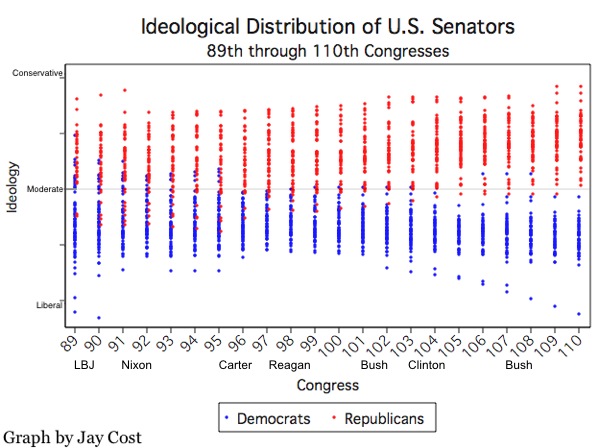
He then goes on to explain:
Three important trends are evident from this picture. First, the party extremes have grown farther apart. Second, there are now fewer genuine moderates in the United States Senate than at any point in the last half century. Third, there used to be a sizeable ideological overlap between the two parties in the Senate. It no longer exists. Put simply, the Senate parties have become ideologically polarized.Cost goes on to explain that removing this tool would make the upper chamber a more chaotic place. The majority party would only have to convince 51 rather than 60 Senators and they would pass more partisan legislation because there would be no check to moderate legislation. Also Cost notes that this would make for unstable policy coming from Washington. Legislation passed when one party is in power would be rescinded when the other party comes to power. Cost notes:
This helps explain the increasing use of the filibuster. As the parties drift apart ideologically, the majority party will more likely introduce legislation that the minority party can't accept, giving the latter a stronger incentive to block it via the filibuster. Using the filibuster is thus a rational response when one finds oneself in the smaller half of a polarized chamber, which is more likely to be the case today than 45 years ago.
If nothing more than a simple majority is necessary for sweeping changes, what stops a newly victorious party from undoing all the reforms implemented by the old majority, and instituting its own set of big changes? What would be the long-term consequences of that? If every biennial or quadrennial election brought the prospect of big changes in public policy - how could we practically plan for the future? We all expect things in 2013 to be generally the same as things in 2009. Eliminate the filibuster, empower a bare majority to impose ideologically extreme policies, and that expectation could become unreasonable.If you are still reading this post, you can probably guess that I am in favor of keeping the filibuster. As Cost notes, moderates are becoming less and less rare in the Senate, and Congress as a whole. It was the moderates that were the dealmakers that could get legislation passed. A bill proposed by the Democrats would have some Republican support and visa versa. But as the parties become more polarized, it only makes sense that when one party proposes a bill, the other party will oppose it. It also means that the party in power is really in power and the filibuster is the only tool the losing party has.
Klein and others are mad that there had to be so much work done to get 60 votes for health care to pass. If there were no filibuster then a health care reform bill would pass, probably with a public option. The remaining moderates in the Democratic party would be sidelined, and the liberal base would become even more powerful. That would be music to Klein's ears, but I think it would be bad in the long run for American democracy.
Part of the problem with our polarized climate today is that when one party wins an election, party stalwarts tend to think this is a mandate from the people to get their own agendas done. They also think that a losing party basically has to sit there and take it. So, in the health care debate, Democrats think that all Republicans should basically shut up since they won the election.
But this isn't a pure democracy, it's a republic that believes that even minorities have to be listened to. People may not like that the GOP was threatening to use the filibuster, but is the only voice the GOP had. The same goes for when the Democrats were the minority party. They need to be able to have some say in how a bill is crafted and absent bridge building moderates, this is how minorities can speak.
Too the winner goes the spoils might work in sports, but not in politics.
Monday, December 28, 2009
Big Tent Democrats?
I've done more than a few posts on the quest by some in the GOP to want shrink the so-called "Big Tent." Many of us have looked at how the Democrats have been able to welcome both liberals and moderates in the party.
However, two articles from two Democrats show that the Left is having its own problems on trying to reach and keep moderates and also please its base.
On Christmas Eve, former Commerce Secretary William Daley wrote in the Washington Post about trying to keep the Dems open to all viewpoints. He notes that Democratic wins in 2006 and 2008 was because the party reached out beyond its liberal base. It was because of the Big Tent, that Dems started winning in Republican-leaning districts for the first time in a long time. But all is now well in the party of FDR. Daley notes that currently liberals in the party are attacking their Centrist brothers and sisters for not being pure enough.
For Daley, the solution is to realize that what might be the agenda of the liberal base might not be the agenda of all Americans:
Nonsense, says Robert Creamer, in the Huffington Post. The political organizer sees any attempt to become more "moderate" as nothing more than bowing to the political interests that got us into this mess called the "Great Recession." Creamer believes the nation voted for substantial change is the Democrats must deliver on this change:
Why does this all sound so familiar to me?
I think what Daley and Creamer show is that polarization really is taking place within the two parties, leaving those not "pure" enough out in the cold. Both hard core liberals and conservatives feel they have a pulse on what America wants and misinterprets an election win for a mandate for radical change.
But of course, they don't understand the outside because their whole political lives are spent inside a bubble of their own making. Moderates in both parties tend to be the ones that know that all of America isn't Berkley or Alabama. They are the ones that have a foot in reality.
Maybe what could happen is that moderates in both parties get tired of being treated like crap and create one or two political parties that are more in tune with the pulse of America. One can hope.
However, two articles from two Democrats show that the Left is having its own problems on trying to reach and keep moderates and also please its base.
On Christmas Eve, former Commerce Secretary William Daley wrote in the Washington Post about trying to keep the Dems open to all viewpoints. He notes that Democratic wins in 2006 and 2008 was because the party reached out beyond its liberal base. It was because of the Big Tent, that Dems started winning in Republican-leaning districts for the first time in a long time. But all is now well in the party of FDR. Daley notes that currently liberals in the party are attacking their Centrist brothers and sisters for not being pure enough.
On the one hand, centrist Democrats are being vilified by left-wing bloggers, pundits and partisan news outlets for not being sufficiently liberal, "true" Democrats. On the other, Republicans are pounding them for their association with a party that seems to be advancing an agenda far to the left of most voters.
The political dangers of this situation could not be clearer.
Witness the losses in New Jersey and Virginia in this year's off-year elections. In those gubernatorial contests, the margin of victory was provided to Republicans by independents -- many of whom had voted for Obama. Just one year later, they had crossed back to the Republicans by 2-to-1 margins.
For Daley, the solution is to realize that what might be the agenda of the liberal base might not be the agenda of all Americans:
All that is required for the Democratic Party to recover its political footing is to acknowledge that the agenda of the party's most liberal supporters has not won the support of a majority of Americans -- and, based on that recognition, to steer a more moderate course on the key issues of the day, from health care to the economy to the environment to Afghanistan.
For liberals to accept that inescapable reality is not to concede permanent defeat. Rather, let them take it as a sign that they must continue the hard work of slowly and steadily persuading their fellow citizens to embrace their perspective. In the meantime, liberals -- and, indeed, all of us -- should have the humility to recognize that there is no monopoly on good ideas, as well as the long-term perspective to know that intraparty warfare will only relegate the Democrats to minority status, which would be disastrous for the very constituents they seek to represent.
Nonsense, says Robert Creamer, in the Huffington Post. The political organizer sees any attempt to become more "moderate" as nothing more than bowing to the political interests that got us into this mess called the "Great Recession." Creamer believes the nation voted for substantial change is the Democrats must deliver on this change:
"Moderating" our goals is not a recipe for victory. It is a recipe for failure. Last fall, voters overwhelming voted for change, and they knew then -- and still know now -- the kind of change they wanted.
They wanted to end the stranglehold of the private insurance companies that continues to put every American a single illness -- or one layoff -- away from financial catastrophe. They want to take bold, clear action to assure that America is in the forefront of creating the clean energy jobs of the future -- and leave a thriving healthy planet to our children. They wanted to fundamentally change the bull-in-the-china shop foreign policy of the Bush years and re-establish American leadership in the world. Most importantly, they rejected the failed economic policies that allowed the recklessness of huge Wall Street banks to plunge the economy into free fall -- and cost millions their livelihoods. They desperately want leadership that will lay the foundation for long term, bottom-up, widely shared prosperity.
In other words they wanted... and still want... fundamental change.
Why does this all sound so familiar to me?
I think what Daley and Creamer show is that polarization really is taking place within the two parties, leaving those not "pure" enough out in the cold. Both hard core liberals and conservatives feel they have a pulse on what America wants and misinterprets an election win for a mandate for radical change.
But of course, they don't understand the outside because their whole political lives are spent inside a bubble of their own making. Moderates in both parties tend to be the ones that know that all of America isn't Berkley or Alabama. They are the ones that have a foot in reality.
Maybe what could happen is that moderates in both parties get tired of being treated like crap and create one or two political parties that are more in tune with the pulse of America. One can hope.
Tuesday, September 22, 2009
Why the NEA Affair Matters
 Conor Friedersdorf and Freddie deBoer have had a tit-for-tat over the whole controversy about someone from the National Endowment for the Arts "inappropriate" actions during a conference call last month. The conservative new site Big Government broke the story. Yosi Sargeant, the communications director for the National Endownment for the Arts was part of this conference call and made statements that flirted with the kind of political nonsense that left a nasty taste during the Bush years.
It would be easy to dismiss this story as I believe Freddie did. After all, the allegations came from a partisan website which has an axe to grind. deBoer thinks it's quite rich that conservatives are shocked since they did the same thing very recently:
It does indeed bother me that the ideology responsible for having people sign written pledges declaring their support for President Bush before they see our elected officials speak now complains about this. It does indeed piss me off that a few short years ago, Republicans were routinely doing things like calling for Howard Dean's hanging for criticizing the war in Iraq, and yet now they stand enraged over this meaningless conference call. It does indeed make me angry that the president himself declared that anti-Iraq war argument "gives comfort to our enemies," and yet now I read Conor Friedersdorf calling for national prominence on this nothing of a story. Yes, indeed, it makes me angry that a party and ideology that represented nothing more forcefully or loudly than the notion that dissent was unpatriotic and treasonous, and that supporting the president and his aims were our solemn duties, now turn around and complain about something like this. Yes, that makes me angry.
Of course. all of this did happen. I remember it all and as a Republican, I found it reprehensible. That said, it seems that Freddie is painting to big a brush here, trying to tar and feather anyone that dares to call themselves a conservative. deBoer only has to read some of Conor's past blog posts to know that he is as upset at the current state of conservatism as anyone else. Freddie's condemnation of not just those in the Bush administration or a number of Republicans, but an entire ideology ,is not only simple-minded, it's mean. There are many good conservatives that wanted nothing to do with this behavior. His rant basically condemned us all.
I believe the whole story matters. I don't have anything against the NEA and I'm not looking to bring down the Obama Administration. But it matters because we have an employee of a government agency working in a capacity that was dancing dangerously close to propaganda.
We also have someone who represents an agency that is in the business of giving out money. While there might have not been any intent to influence people, the fact that the communications director of the NEA was on a call with artists where the intent political looks really bad. Seargant should have known better.
If the Obama Administration wants to get artists involved to push their agenda, fine. They can do that through groups like Organizing for America. But leave the NEA out of this. This is a government agency that is supposed to support all Americans, not just the ones that support whoever is in office.
In a response to Freddie, Conor lifts this quote from a commenter:
The NEA is not a tool of (administration) policy, and that’s the scandal here. I realize that this issue isn’t as crucial to some of you young’uns; I remember when the NEA was criticized heavily for funding to Mapplethorpe and “Piss Christ” and the like. Well, for one thing I think most Americans thought that that was “good” censorship. But for another liberals at that time stood for the idea that the NEA is not a policy tool. We fought the idea that conservatives should be interested in gutting it because of the messages of the art it funded, with the belief that the NEA didn’t exist to “message.” The NEA director isn’t supposed to be interested in the messaging of the art: he’s supposed to want to know to whom it’s accessible, if it’s introducing more and more diverse art into a community, if it’s something that can promote arts education, if it’s keeping a classic American form vibrant…
You would tear that up. Conservatives would then be well advised to kill the NEA and NEH and Smithsonian and intellectuals would be deprived of a good argument as to why that’s a bad idea. Now, some of us don’t share the TAS enthusiasm for crapola hipster bands, and the jazz I live on is pretty dependent on organiztions like the NEA, and not really very good for messaging. So I want this bullshit killed, and somebody from the Obama administration fired.
You want to keep kids in school and encourage service and so on with clever art? Use the fucking Ad council. Immediate thought: Jesus, you really do need to read Europe Central or some of Belinsky’s misguided takedowns of non-programmatic art from the late Romantics/early Realists. Those guys thought like you are. Thinking this isn’t a pretty serious deal is failing to realize how much art actually means — which is why we have an NEA.
I was in college when conservatives attacked the NEA in the early 90s for its funding of art that some deemed offensive. It was wrong then for conservatives to try to politicize the NEA then and it's wrong for liberals to try to attempt to do the same thing now.
Let the NEA do what it is good at doing: supporting the arts in America.
Wednesday, September 09, 2009
The Obama Health Care Speech: One Republican's View
I heard most the President's speech tonight over the radio. Here are some of what I thought were highlights and what I thought.
I don't have a problem with this provision. I've long believed that denying someone insurance because of pre-existing conditions, or using the horrible practice of recission should be against the law.
He makes a nod to the co-op idea and to the idea that market forces should bring prices down. He includes subsidies for those who can't purchase health care and seems to back a catastrophic insurance scheme that was devised by his 2008 opponent, John McCain. Smart move there. All in all, there are things for someone like me to love.
Hmmm...this I don't get. If we have consumer protections and regulation (good), and we have companies competing and bringing down prices (also good), and we have subsidies to help those who can't afford the premiums (really good), then why do we need a "public option?" It just seems like the answer to a question no one is asking.
That said, I do like that he is looking to make it be funded not by taxes, but by premiums.
Another hmmm moment. Other than the tax on so-called "Cadillac" plans, I don't see how tackling the old monster of "waste, fraud and abuse" is going to not make this plan a budget buster.
As for his partisan dig at Republicans for leaving a big deficit? Well, it was partisan, but it was also true. Moving on...
I think this is a worthwhile idea and it throws something to the GOP. Will the Republicans take it? I don't know.
All in all, it was a good speech and he did put some more flesh on the bones of his plan. My problems with it is that he still has not really given a reasonable explaination as to why we need a public option and has not really tackled how to best pay for this plan in a way that won't bust the already busted budget. He also has not taken on the idea of junking the idea of employer-provided insurance, something that doesn't work in this age of employment mobility. My guess is that killing employer provided care would mean taking on labor, one the building blocks of the Democratic coalition.
The question remains if he can get Democrats to agree on this, and if Republicans are willing to step up and work on the plan.
I've said it before, but I think we need health care reform. The question remains if Obama's plan is a plan that will work.
What this plan will do is to make the insurance you have work better for you. Under this plan, it will be against the law for insurance companies to deny you coverage because of a pre-existing condition. As soon as I sign this bill, it will be against the law for insurance companies to drop your coverage when you get sick or water it down when you need it most. They will no longer be able to place some arbitrary cap on the amount of coverage you can receive in a given year or a lifetime. We will place a limit on how much you can be charged for out-of-pocket expenses, because in the United States of America, no one should go broke because they get sick. And insurance companies will be required to cover, with no extra charge, routine checkups and preventive care, like mammograms and colonoscopies - because there's no reason we shouldn't be catching diseases like breast cancer and colon cancer before they get worse. That makes sense, it saves money, and it saves lives.
I don't have a problem with this provision. I've long believed that denying someone insurance because of pre-existing conditions, or using the horrible practice of recission should be against the law.
Now, if you're one of the tens of millions of Americans who don't currently have health insurance, the second part of this plan will finally offer you quality, affordable choices. If you lose your job or change your job, you will be able to get coverage. If you strike out on your own and start a small business, you will be able to get coverage. We will do this by creating a new insurance exchange - a marketplace where individuals and small businesses will be able to shop for health insurance at competitive prices. Insurance companies will have an incentive to participate in this exchange because it lets them compete for millions of new customers. As one big group, these customers will have greater leverage to bargain with the insurance companies for better prices and quality coverage. This is how large companies and government employees get affordable insurance. It's how everyone in this Congress gets affordable insurance. And it's time to give every American the same opportunity that we've given ourselves.
For those individuals and small businesses who still cannot afford the lower-priced insurance available in the exchange, we will provide tax credits, the size of which will be based on your need. And all insurance companies that want access to this new marketplace will have to abide by the consumer protections I already mentioned. This exchange will take effect in four years, which will give us time to do it right. In the meantime, for those Americans who can't get insurance today because they have pre-existing medical conditions, we will immediately offer low-cost coverage that will protect you against financial ruin if you become seriously ill. This was a good idea when Senator John McCain proposed it in the campaign, it's a good idea now, and we should embrace it.
He makes a nod to the co-op idea and to the idea that market forces should bring prices down. He includes subsidies for those who can't purchase health care and seems to back a catastrophic insurance scheme that was devised by his 2008 opponent, John McCain. Smart move there. All in all, there are things for someone like me to love.
Now, I have no interest in putting insurance companies out of business. They provide a legitimate service, and employ a lot of our friends and neighbors. I just want to hold them accountable. The insurance reforms that I've already mentioned would do just that. But an additional step we can take to keep insurance companies honest is by making a not-for-profit public option available in the insurance exchange. Let me be clear - it would only be an option for those who don't have insurance. No one would be forced to choose it, and it would not impact those of you who already have insurance. In fact, based on Congressional Budget Office estimates, we believe that less than 5% of Americans would sign up.
Despite all this, the insurance companies and their allies don't like this idea. They argue that these private companies can't fairly compete with the government. And they'd be right if taxpayers were subsidizing this public insurance option. But they won't be. I have insisted that like any private insurance company, the public insurance option would have to be self-sufficient and rely on the premiums it collects. But by avoiding some of the overhead that gets eaten up at private companies by profits, excessive administrative costs and executive salaries, it could provide a good deal for consumers. It would also keep pressure on private insurers to keep their policies affordable and treat their customers better, the same way public colleges and universities provide additional choice and competition to students without in any way inhibiting a vibrant system of private colleges and universities.
Hmmm...this I don't get. If we have consumer protections and regulation (good), and we have companies competing and bringing down prices (also good), and we have subsidies to help those who can't afford the premiums (really good), then why do we need a "public option?" It just seems like the answer to a question no one is asking.
That said, I do like that he is looking to make it be funded not by taxes, but by premiums.
Finally, let me discuss an issue that is a great concern to me, to members of this chamber, and to the public - and that is how we pay for this plan.
Here's what you need to know. First, I will not sign a plan that adds one dime to our deficits - either now or in the future. Period. And to prove that I'm serious, there will be a provision in this plan that requires us to come forward with more spending cuts if the savings we promised don't materialize. Part of the reason I faced a trillion dollar deficit when I walked in the door of the White House is because too many initiatives over the last decade were not paid for - from the Iraq War to tax breaks for the wealthy. I will not make that same mistake with health care.
Second, we've estimated that most of this plan can be paid for by finding savings within the existing health care system - a system that is currently full of waste and abuse. Right now, too much of the hard-earned savings and tax dollars we spend on health care doesn't make us healthier. That's not my judgment - it's the judgment of medical professionals across this country. And this is also true when it comes to Medicare and Medicaid.
Reducing the waste and inefficiency in Medicare and Medicaid will pay for most of this plan. Much of the rest would be paid for with revenues from the very same drug and insurance companies that stand to benefit from tens of millions of new customers. This reform will charge insurance companies a fee for their most expensive policies, which will encourage them to provide greater value for the money - an idea which has the support of Democratic and Republican experts. And according to these same experts, this modest change could help hold down the cost of health care for all of us in the long-run.
Another hmmm moment. Other than the tax on so-called "Cadillac" plans, I don't see how tackling the old monster of "waste, fraud and abuse" is going to not make this plan a budget buster.
As for his partisan dig at Republicans for leaving a big deficit? Well, it was partisan, but it was also true. Moving on...
Finally, many in this chamber - particularly on the Republican side of the aisle - have long insisted that reforming our medical malpractice laws can help bring down the cost of health care. I don't believe malpractice reform is a silver bullet, but I have talked to enough doctors to know that defensive medicine may be contributing to unnecessary costs. So I am proposing that we move forward on a range of ideas about how to put patient safety first and let doctors focus on practicing medicine. I know that the Bush Administration considered authorizing demonstration projects in individual states to test these issues. It's a good idea, and I am directing my Secretary of Health and Human Services to move forward on this initiative today.
I think this is a worthwhile idea and it throws something to the GOP. Will the Republicans take it? I don't know.
All in all, it was a good speech and he did put some more flesh on the bones of his plan. My problems with it is that he still has not really given a reasonable explaination as to why we need a public option and has not really tackled how to best pay for this plan in a way that won't bust the already busted budget. He also has not taken on the idea of junking the idea of employer-provided insurance, something that doesn't work in this age of employment mobility. My guess is that killing employer provided care would mean taking on labor, one the building blocks of the Democratic coalition.
The question remains if he can get Democrats to agree on this, and if Republicans are willing to step up and work on the plan.
I've said it before, but I think we need health care reform. The question remains if Obama's plan is a plan that will work.
Wednesday, August 26, 2009
The Lion Sleeps Tonight
I saw Ted Kennedy once.
It was the summer of 1990 and I was working in DC as a congressional intern for my representative. For some reason, I and several other interns went to the Capitol Rotunda where a ceremony was taking place: the 25th anniversary of the signing of the Voting Rights Act. As we stood behind a rope, I could see Kennedy walking up and chatting with other Representatives and Senators. I remember being excited at seeing the Senator. Here was a man whose brother was the President, his last name was attached to one the greatest political families in the nation.
When I woke up this morning to the news that Ted Kennedy has succumb to the brain cancer he fought, I felt a deep sense of sadness, even though I disagreed with him. They don't make them like him anymore.
Make no mistake, Kennedy was a staunch liberal and represented the left wing of the Democratic Party. But what was interesting is that even though he had strong opinions and passions, he was able to reach across the isle and work with Republicans to get things done. It seems like he was always working with the likes of Republican Senators like Orin Hatch or John McCain on some bill or another.
Kennedy is the one of the last of a long line of statesman who showed that one can have strong convictions and also cut a deal. That's something that is becoming a lost art these days, as Ronald Brownstein notes in an article about Kennedy's passing. We live in an age where we have convictions, but not much else. Cutting a deal is seen as something akin to treason.
Kennedy, and to some extent, John McCain, reminded us that being an elected official means having to actually govern. Governing means that you have to work with those that might disagree with you and trying to come to some solution that all sides can work with.
Today's political climate is one where we are stuck in a permanent campaign mode. Blogs, special interests groups and talk show hosts do all they can to paint the other side as monsters bent on destroying all that they hold dear.
In doing this, we ignore the issues that really matter; whether that is health care reform, climate change or social security reform. Politics today is all sound and fury, signifying nothing.
Kennedy's passing is not just the death of a figure who made an impact in American life; it is slow death of a climate where people, liberals and conservatives were more interested in finding solutions that in being right.
So, I mourn the death of the "Lion." Senator, know that one Republican thinks the world is a lot less brighter with you not in it.
It was the summer of 1990 and I was working in DC as a congressional intern for my representative. For some reason, I and several other interns went to the Capitol Rotunda where a ceremony was taking place: the 25th anniversary of the signing of the Voting Rights Act. As we stood behind a rope, I could see Kennedy walking up and chatting with other Representatives and Senators. I remember being excited at seeing the Senator. Here was a man whose brother was the President, his last name was attached to one the greatest political families in the nation.
When I woke up this morning to the news that Ted Kennedy has succumb to the brain cancer he fought, I felt a deep sense of sadness, even though I disagreed with him. They don't make them like him anymore.
Make no mistake, Kennedy was a staunch liberal and represented the left wing of the Democratic Party. But what was interesting is that even though he had strong opinions and passions, he was able to reach across the isle and work with Republicans to get things done. It seems like he was always working with the likes of Republican Senators like Orin Hatch or John McCain on some bill or another.
Kennedy is the one of the last of a long line of statesman who showed that one can have strong convictions and also cut a deal. That's something that is becoming a lost art these days, as Ronald Brownstein notes in an article about Kennedy's passing. We live in an age where we have convictions, but not much else. Cutting a deal is seen as something akin to treason.
Kennedy, and to some extent, John McCain, reminded us that being an elected official means having to actually govern. Governing means that you have to work with those that might disagree with you and trying to come to some solution that all sides can work with.
Today's political climate is one where we are stuck in a permanent campaign mode. Blogs, special interests groups and talk show hosts do all they can to paint the other side as monsters bent on destroying all that they hold dear.
In doing this, we ignore the issues that really matter; whether that is health care reform, climate change or social security reform. Politics today is all sound and fury, signifying nothing.
Kennedy's passing is not just the death of a figure who made an impact in American life; it is slow death of a climate where people, liberals and conservatives were more interested in finding solutions that in being right.
So, I mourn the death of the "Lion." Senator, know that one Republican thinks the world is a lot less brighter with you not in it.
Monday, August 17, 2009
Whole Fools
I rarely shop at Whole Foods, which has two locations in the Twin Cities. If I am looking for organic foods, I tend to look for them at the regular grocery store I shop at or go to Trader Joes, which one person described as the "poor man's Whole Foods."
But I might consider shopping at the grocery chain more in the near future because of the insane and asinine boycott going on by some on the Left. Why would people who normaly shop at the organic retailer decide to abstain? Because their CEO wrote an op-ed in the Wall Street Journal denouncing the Obama plan and offering a plan of his own.
I read that oped and thought it was interesting. I didn't agree with everything, but Mackey made some good points and I thought nothing more of the article.
But obviously it did upset some people who expected that Mr. Mackey should support what they support. This is what was written in a guest voice post at the Moderate Voice:
A Facebook group has been set up and has about 10,000 members. Here's the description of that group:
Whole Foods? Right-wing?
I decided to take a look at the activities going on at my local Whole Foods in Minneapolis. They have a program where you save 10 cents on using reusable bags and you can donate that money to a local charity. The Whole Foods Blog has a campaign to have fresh and healthy school lunches as opposed to the processed foods that kids eat. From my cursory glance, this is hardly a right-wing operation.
Radley Balko shares some of what this "right-wing operation" has done:
Blogger Freddie DeBoer thinks all the harping on the right about this (in this case a blog post by Rod Dreher) is hypocritical, but the fact is there is a lot of hypocrisy on both sides. Liberals tut-tut when conservatives try to strong arm those who don't agree with them and ignore their own attitudes towards those who have different ideas.
What is interesting here is how so many who used to support Whole Foods think that the company should basically affirm their views. If they support health care reform with a strong role for government, well, then so must Whole Foods. They also tend to assume that beacuse they are "green" and organic, well then they must be left-leaning just like they themselves are.
The fact of the matter is, one can care about the environment and also be a libertarian. One can be into organic foods and vote Republican. Just because someone buys fair-trade coffee doesn't mean they voted for Obama. It just means they like fair trade coffee.
When I buy ice cream, I tend to get Ben and Jerry's ice cream even though I tend to disagree with them politcally. But I also know they do some good things in the world and they have good ice cream. I don't need my ice cream company to agree with me 100 percent.
The problem here is not that Mackey doesn't support the President's plan. The problem here is assuming that Mackey should mirror the view points of Whole Foods' customers.
But I might consider shopping at the grocery chain more in the near future because of the insane and asinine boycott going on by some on the Left. Why would people who normaly shop at the organic retailer decide to abstain? Because their CEO wrote an op-ed in the Wall Street Journal denouncing the Obama plan and offering a plan of his own.
I read that oped and thought it was interesting. I didn't agree with everything, but Mackey made some good points and I thought nothing more of the article.
But obviously it did upset some people who expected that Mr. Mackey should support what they support. This is what was written in a guest voice post at the Moderate Voice:
The thing is, when Rupuert Murdoch published an anti-health care security op-ed from Whole Foods CEO John Mackey in yesterday’s Wall Street Journal, a few progressive latte drinkers decided they didn’t need to buy their arugula at Whole Foods anymore, and called for a boycott. After all, the big marketing gimmick for Whole Foods is that they’re a socially responsible company which sells food that is actually good for you (even if the products are very over priced)...
Whole Foods has always marketed itself to a fairly educated and financially secure customer base. This is why they can successfully sell healthy (and primarily organic) foods, at a higher cost. The company has also fostered the image that it has an altruistic streak in supporting progressive causes.
With a single op-ed in an uber conservative national newspaper, this wholesome image has been blown to bits. In the course of writing 1,165 words, CEO Mackey has caused more potential damage to the Whole Foods corporate image than an e-coli outbreak in the meat room.
In calling for support of the boycott of Whole Foods, I’m making an educated guess that their average customer is very politically progressive in nature. And that is why, if liberals and progressives quit shopping at Whole Foods, the impact would be quickly apparent to the company’s Board of Directors. By quickly, I mean by this coming Monday morning when the weekend receipts are tallied.
A Facebook group has been set up and has about 10,000 members. Here's the description of that group:
Whole Foods is NOT a company that cares for communities and they have built their brand with the dollars of deceived progressives. No more. My $ will no longer go to support Whole Foods' anti-union, anti-health insurance reform, right-wing activities.
Whole Foods? Right-wing?
I decided to take a look at the activities going on at my local Whole Foods in Minneapolis. They have a program where you save 10 cents on using reusable bags and you can donate that money to a local charity. The Whole Foods Blog has a campaign to have fresh and healthy school lunches as opposed to the processed foods that kids eat. From my cursory glance, this is hardly a right-wing operation.
Radley Balko shares some of what this "right-wing operation" has done:
Let me see if I have the logic correct here: Whole Foods is consistently ranked among the most employee-friendly places to work in the service industry. In fact, Whole Foods treats employees a hell of a lot better than most liberal activist groups do. The company has strict environmental and humane animal treatment standards about how its food is grown and raised. The company buys local. The store near me is hosting a local tasting event for its regional vendors. Last I saw, the company’s lowest wage earners make $13.15 per hour. They also get to vote on what type of health insurance they want. And they all get health insurance. The company is also constantly raising money for various philanthropic causes. When I was there today, they were taking donations for a school lunch program. In short, Whole Foods is everything leftists talk about when they talk about “corporate responsibility.”
And yet lefties want to boycott the company because CEO John Mackey wrote an op-ed that suggests alternatives to single payer health care? It wasn’t even a nasty or mean-spirited op-ed. Mackey didn’t spread misinformation about death panels, call anyone names, or use ad hominem attacks. He put forth actual ideas and policy proposals, many of them tested and proven during his own experience running a large company. Is this really the state of debate on the left, now? “Agree with us, or we’ll crush you?”
Blogger Freddie DeBoer thinks all the harping on the right about this (in this case a blog post by Rod Dreher) is hypocritical, but the fact is there is a lot of hypocrisy on both sides. Liberals tut-tut when conservatives try to strong arm those who don't agree with them and ignore their own attitudes towards those who have different ideas.
What is interesting here is how so many who used to support Whole Foods think that the company should basically affirm their views. If they support health care reform with a strong role for government, well, then so must Whole Foods. They also tend to assume that beacuse they are "green" and organic, well then they must be left-leaning just like they themselves are.
The fact of the matter is, one can care about the environment and also be a libertarian. One can be into organic foods and vote Republican. Just because someone buys fair-trade coffee doesn't mean they voted for Obama. It just means they like fair trade coffee.
When I buy ice cream, I tend to get Ben and Jerry's ice cream even though I tend to disagree with them politcally. But I also know they do some good things in the world and they have good ice cream. I don't need my ice cream company to agree with me 100 percent.
The problem here is not that Mackey doesn't support the President's plan. The problem here is assuming that Mackey should mirror the view points of Whole Foods' customers.
Monday, August 03, 2009
Keep It In the Closet
During the election last year, we were reminded again and again that Barack Obama was in the vanguard on gay rights, while John McCain was incredibly anti-gay. Nevermind that both candidates had basically the same position on gay marriage: they were against it.
When Obama became President, many liberals and not quite a few Republicans believed that he would advance the cause for gay rights. So far, he hasn't done that much. He has dragged his feet on allowing gays to serve in the military and basically defended gay marriage in terms that make you wonder if we elected the late Jesse Helms to the presidency.
And yet, as James Kirchick writes in Sunday's Washington Post, many liberals still maintain that the President is "secretly" supports them.
This is nothing new. As Kirchick notes, gay Democrats have long maintained that President Bill Clinton supported gay marriage and was forced into signing the Defense of Marriage Act back in 1996 to keep the Republicans from attacking him. Nevermind he then talked about it in radio ads and even counseled John Kerry to not support gay marriage in Kerry's 2004 campaign.
Many liberals tout the passage to work for gay marriage as well as serving in the military as the civil rights issue of our time. On that, I agree. But where I disagee is that while many of liberal friends talk about how this is the new civil rights struggle, in reality this is nothing more than partisan politics dressed up in civil rights garb.
As Dave Andesik notes, if a Democrat was spouting racist talk in public no one would say that such a person secretly supports a certain ethnic or racial group. But yet, when a Democrat opposes gay marriage, he is viewed as a secret supporter, while a Republican who has the identical position is not viewed with such kindness.
If this were truly an issue of human rights, then gay Democrats would demand that their Democratic politicians would support their cause of face the consequences. They would not only castigate Republicans, but their own candidates in the cause of the greater good of gay rights.
Which is why I think that the cause of gay rights will be impeded as long as gay leaders confuse party loyalty with human rights. As long as the gay community sucks up to Democrats that won't support them, we can expect a long hard road towards gay equality.
When Obama became President, many liberals and not quite a few Republicans believed that he would advance the cause for gay rights. So far, he hasn't done that much. He has dragged his feet on allowing gays to serve in the military and basically defended gay marriage in terms that make you wonder if we elected the late Jesse Helms to the presidency.
And yet, as James Kirchick writes in Sunday's Washington Post, many liberals still maintain that the President is "secretly" supports them.
This is nothing new. As Kirchick notes, gay Democrats have long maintained that President Bill Clinton supported gay marriage and was forced into signing the Defense of Marriage Act back in 1996 to keep the Republicans from attacking him. Nevermind he then talked about it in radio ads and even counseled John Kerry to not support gay marriage in Kerry's 2004 campaign.
Many liberals tout the passage to work for gay marriage as well as serving in the military as the civil rights issue of our time. On that, I agree. But where I disagee is that while many of liberal friends talk about how this is the new civil rights struggle, in reality this is nothing more than partisan politics dressed up in civil rights garb.
As Dave Andesik notes, if a Democrat was spouting racist talk in public no one would say that such a person secretly supports a certain ethnic or racial group. But yet, when a Democrat opposes gay marriage, he is viewed as a secret supporter, while a Republican who has the identical position is not viewed with such kindness.
If this were truly an issue of human rights, then gay Democrats would demand that their Democratic politicians would support their cause of face the consequences. They would not only castigate Republicans, but their own candidates in the cause of the greater good of gay rights.
Which is why I think that the cause of gay rights will be impeded as long as gay leaders confuse party loyalty with human rights. As long as the gay community sucks up to Democrats that won't support them, we can expect a long hard road towards gay equality.
Wednesday, July 15, 2009
Is Sotomayor Off Limits?
This blog post by Craig Crawford has me puzzled:
This post and another one by fellow moderate GOPer Sophia Nelson, has me wondering: are liberal persons of color who are to be nominated just supossed to glide through hearings, never asked any tough questions?
I have argued in the past and still maintain that Republicans should not try to block Sotomayor's nomination to the Supreme Court because for the very same reasons. And I would certainly agree that there needs to be more diversity among the GOP.
That said, I think the GOP can and should ask some probing questions. What did she mean by her "wise Latina" remark? Can she explain her ruling in the Ricci case? Probing the judge is not akin to being a racist.
The thing is, if the circumstance were reversed, and it was President Bush nominating a Hispanic judge to the Supreme Court, I doubt that Crawford would be wagging his finger when Democratic Senators starting asking tough questions to the nominee, as would be their right.
The fact that persons of color such as President Obama and Sotomayor are taking positions of power in our society is a great thing and it means we are living up to the promise E Pluribus Unum. But that also means we as persons of color have to be big boys and girls and take the slings and arros that come on the political stage.
As a fellow Puerto Rican, I am proud to see Sotomayor being considered, and hope that she will make a good justice. But that Pride doesn't mean tossing her softball questions.
Watching Lindsey Graham's gotcha grin as he needled Supreme Court nominee Sonia Sotomayor with disingenuous and rhetorical questions you had to wonder what was so funny.
Does the Republican senator think it is amusing that he and his party's condescending tone toward the Hispanic woman was costing them ethnic votes with each passing hour of Tuesday's Judiciary Committee hearing?
It is not that the Republican inquiries were out of bounds in legal terms. But a confirmation hearing like this is a political forum.
Even if they vote for her, the fallout for Republicans could reach well beyond Hispanic voters. They are coming across as a bunch of snarky and bitter old white men who cannot bear the thought of their kind losing power.
The impact of this story on the political scoreboard should give Democrats much more to smile about.
This post and another one by fellow moderate GOPer Sophia Nelson, has me wondering: are liberal persons of color who are to be nominated just supossed to glide through hearings, never asked any tough questions?
I have argued in the past and still maintain that Republicans should not try to block Sotomayor's nomination to the Supreme Court because for the very same reasons. And I would certainly agree that there needs to be more diversity among the GOP.
That said, I think the GOP can and should ask some probing questions. What did she mean by her "wise Latina" remark? Can she explain her ruling in the Ricci case? Probing the judge is not akin to being a racist.
The thing is, if the circumstance were reversed, and it was President Bush nominating a Hispanic judge to the Supreme Court, I doubt that Crawford would be wagging his finger when Democratic Senators starting asking tough questions to the nominee, as would be their right.
The fact that persons of color such as President Obama and Sotomayor are taking positions of power in our society is a great thing and it means we are living up to the promise E Pluribus Unum. But that also means we as persons of color have to be big boys and girls and take the slings and arros that come on the political stage.
As a fellow Puerto Rican, I am proud to see Sotomayor being considered, and hope that she will make a good justice. But that Pride doesn't mean tossing her softball questions.
Wednesday, June 17, 2009
Keeping Them Honest
One of the more controversial aspects of President Obama's health care plan is the inclusion of a "public option" run by the government. The reason to have such an option mixed in with private plans, is to keep the private insurers honest.
I've always found this an odd assertion: that the only way to keep the private plans running well and playing fair is to have a government-run plan. Isn't regulation a better way of keeping the private plans honest?
For Republicans and moderate or conservative Democrats, the mention of a public plan makes them nervous. There are fears that a public-plan will under cut private plans in price and effectively run those insurers out of business, leaving a defacto single-payer system in the United States.
Such a prospect is fine with liberal Democrats who have no love for the current system. The liberal base of the Democratic Party has long championed single-payer ala Canada, and Obama might be sneaking it in through the back door.
Clive Crook has a good article in the Financial Times about the prospect of a single-payer system in the US. Even though I am not a fan of single-payer, Crook does a good job of showing its benefits which are appealing:
So a health care system based on Medicare could control costs, provide choice, and make health care more portable. All good things.
So, what are the down sides? Crook continues:
So, a single-payer system could impede innovation which could also slow cutting costs. Not so good. Crook goes on to note that the whole "keeping them honest" line would mean that the public plan would have to play hardball: using its might to force down payments and make the market less competative.
In the end, I think that if the President want to keep the private insurers honest, then he should as Crook argues, favor a regulated private system, something I support. If they really think the government should be running the show, they should just say so and give good reasons why such a route is better.
I've always found this an odd assertion: that the only way to keep the private plans running well and playing fair is to have a government-run plan. Isn't regulation a better way of keeping the private plans honest?
For Republicans and moderate or conservative Democrats, the mention of a public plan makes them nervous. There are fears that a public-plan will under cut private plans in price and effectively run those insurers out of business, leaving a defacto single-payer system in the United States.
Such a prospect is fine with liberal Democrats who have no love for the current system. The liberal base of the Democratic Party has long championed single-payer ala Canada, and Obama might be sneaking it in through the back door.
Clive Crook has a good article in the Financial Times about the prospect of a single-payer system in the US. Even though I am not a fan of single-payer, Crook does a good job of showing its benefits which are appealing:
In my view, there are worse things than Medicare for all – and the present system might be one of them. Medicare for all would give the US truly universal coverage and better control of costs. It would preserve choice of doctor and hospital, and private insurance for supplementary services could co-exist for those who wanted it. The demise of employer-provided plans would make labour more mobile and relieve workers of the worry that losing their job means losing their health insurance.
So a health care system based on Medicare could control costs, provide choice, and make health care more portable. All good things.
So, what are the down sides? Crook continues:
A less obvious objection is that a healthy private insurance market is worth preserving. The seething hatred many Democrats – and many other Americans of no fixed ideology – feel for private health insurers ignores the value they bring – and the extra value they could add if their incentives were better designed and their customers had the information they needed to make intelligent choices.
If competition is a good thing, competition among insurance providers is a good thing too. Yes, abolishing it reduces one kind of lump-sum administrative overhead, which is all some Democrats seem to care about. But it also abolishes pressures for innovation and other kinds of cost reduction. In other industries, competition pays for itself in spite of the apparent waste of marketing and other forms of duplicated effort. Healthcare is different – but not that different. At the very least, one should pause before shutting competition down.
So, a single-payer system could impede innovation which could also slow cutting costs. Not so good. Crook goes on to note that the whole "keeping them honest" line would mean that the public plan would have to play hardball: using its might to force down payments and make the market less competative.
In the end, I think that if the President want to keep the private insurers honest, then he should as Crook argues, favor a regulated private system, something I support. If they really think the government should be running the show, they should just say so and give good reasons why such a route is better.
Tuesday, June 16, 2009
Outsourcing Gay Rights
A dear friend of mine who happens to also be a gay moderate Republican, thought that the upside of Obama would be that some social issues like gay rights would actually gain ground. As the past few months have passed, I have to wonder what my friend is thinking now.
The New York Times has a very strong editorial taking the President to task for not doing enough on the subject of gay rights. The Justice Department supported keeping the Defense of Marriage Act in place using reasoning that one would not expect to hear from a Democrat.
Because Democrats are all for gay rights, correct?
As a gay Republican who has had to withstand the many slings and arrows of gay Democrats, it would be easy for me to make fun of this development. But the fact that gay rights are being impeded, makes it hard to laugh. Actually, one wants to cry.
In some way though, the gay community has no one to blame for this than ourselves. For years the rhetoric has been to let the Democrats take care of securing gay rights. So, gays have voted for Democrats and the result has been...well not much.
I'm not saying that the Republicans would do a better job- I'd have to be on drugs to say that looking at the current state of the GOP. But I am saying that if gay Americans want to be treated as full and equal citizens, then we are going to fight for them ourselves and not outsource it to the Democrats.
If gay Democrats are upset at Obama's performance so far (and many are) then now is time to pressure the White House to stop acting like cowards. It's time for gay couples to be treated as equals by Uncle Sam and for men and women to be able to serve their country in our military without fear of being discharged for being honest. If a nation like Israel, hardly a wimpy nation, can have gays serving openly in their military, then so can we.
It's way past the time that the gay community starts hittin' the streets to demand equality and not simply be told to be patient.
The New York Times has a very strong editorial taking the President to task for not doing enough on the subject of gay rights. The Justice Department supported keeping the Defense of Marriage Act in place using reasoning that one would not expect to hear from a Democrat.
Because Democrats are all for gay rights, correct?
As a gay Republican who has had to withstand the many slings and arrows of gay Democrats, it would be easy for me to make fun of this development. But the fact that gay rights are being impeded, makes it hard to laugh. Actually, one wants to cry.
In some way though, the gay community has no one to blame for this than ourselves. For years the rhetoric has been to let the Democrats take care of securing gay rights. So, gays have voted for Democrats and the result has been...well not much.
I'm not saying that the Republicans would do a better job- I'd have to be on drugs to say that looking at the current state of the GOP. But I am saying that if gay Americans want to be treated as full and equal citizens, then we are going to fight for them ourselves and not outsource it to the Democrats.
If gay Democrats are upset at Obama's performance so far (and many are) then now is time to pressure the White House to stop acting like cowards. It's time for gay couples to be treated as equals by Uncle Sam and for men and women to be able to serve their country in our military without fear of being discharged for being honest. If a nation like Israel, hardly a wimpy nation, can have gays serving openly in their military, then so can we.
It's way past the time that the gay community starts hittin' the streets to demand equality and not simply be told to be patient.
Friday, June 12, 2009
Connecting the Dots, Ignoring the Logs
There has been a lot of talk in the press about how the conservative media was to blame for the the horrible shooting at the Holocaust museum this week in addition to the recent murder of Dr. George Tiller a few weeks ago.
Paul Krugman, writing in today's New York Times says that the line between the mainstream right the extreme right has been erased:
He then starts sharing a list of conservative media stars such as Glen Beck and Rush Limbaugh and even actor Jon Voight for stirring up the passions and laying the ground work for extremists.
Now, I really don't care about Rush Limbaugh and think he is symptom of a problem within the GOP. But even I can see that there isn't a straight line between Rush and James Von Brunn, the shooter at the Holocaust Museum.
From reading news reports about Von Brunn, it sounds like he didn't need Rush or Glen Beck to get him angry. He seems to have lived a life filled with hate long before Rush ever took the airwaves.
It's also not like the Left is innocent in talk that has been rather uncivil. As Cathy Young notes, there has been a fair amount of bad talk on the left as well.
In the end, such partisan bickering is really about the lack of civility in our society today. We have become warring political camps and we see the Other as not some that has differing views on politics, but someone that is capable of pure evil.
The other side of this is that each side thinks of themselves as pure and good, standing up to the rising hordes of evil.
It would be nice if folks on the Left and Right would look at the logs in their own eyes before pouncing on their sisters and brother's specks.
It would also be nice if both sides would stop using such tragedies as excuses to prove how evil the other side is. The killing of doctor in a church, and the shooting of guard just doing his job should be a time when the nation comes together, not come apart.
Paul Krugman, writing in today's New York Times says that the line between the mainstream right the extreme right has been erased:
Today, as in the early years of the Clinton administration but to an even greater extent, right-wing extremism is being systematically fed by the conservative media and political establishment.
Now, for the most part, the likes of Fox News and the R.N.C. haven’t directly incited violence, despite Bill O’Reilly’s declarations that “some” called Dr. Tiller “Tiller the Baby Killer,” that he had “blood on his hands,” and that he was a “guy operating a death mill.” But they have gone out of their way to provide a platform for conspiracy theories and apocalyptic rhetoric, just as they did the last time a Democrat held the White House.
And at this point, whatever dividing line there was between mainstream conservatism and the black-helicopter crowd seems to have been virtually erased.
He then starts sharing a list of conservative media stars such as Glen Beck and Rush Limbaugh and even actor Jon Voight for stirring up the passions and laying the ground work for extremists.
Now, I really don't care about Rush Limbaugh and think he is symptom of a problem within the GOP. But even I can see that there isn't a straight line between Rush and James Von Brunn, the shooter at the Holocaust Museum.
From reading news reports about Von Brunn, it sounds like he didn't need Rush or Glen Beck to get him angry. He seems to have lived a life filled with hate long before Rush ever took the airwaves.
It's also not like the Left is innocent in talk that has been rather uncivil. As Cathy Young notes, there has been a fair amount of bad talk on the left as well.
In the end, such partisan bickering is really about the lack of civility in our society today. We have become warring political camps and we see the Other as not some that has differing views on politics, but someone that is capable of pure evil.
The other side of this is that each side thinks of themselves as pure and good, standing up to the rising hordes of evil.
It would be nice if folks on the Left and Right would look at the logs in their own eyes before pouncing on their sisters and brother's specks.
It would also be nice if both sides would stop using such tragedies as excuses to prove how evil the other side is. The killing of doctor in a church, and the shooting of guard just doing his job should be a time when the nation comes together, not come apart.
Monday, March 09, 2009
So, Where are the New Republicans?
Ross Douthat has a good post today about Obama and the Center-Left. He notes that conservatives were happy with some of the Clintonite picks he made in the cabinet. However, as policy started coming out, those same conservatives (myself included) were not as happy.
So what happened? Douthat posed three solutions and it is the third one that makes the most sense:
I think this is correct. What many conservatives (again, myself included) forgot is that the so-called New Democrats ala Bill Clinton, came about because the Dems had lost the presidency several times and were losing key voting blocks. The Republicans were ascendant, so the New Democrats decided to steer the party where the country was at that time.
These days you don't hear much about the New Democrats and they have for the most part, dissapeared. That's mostly because as the Bush Administration drifted ever so rightward, that caused the moderates and liberals in the Democratic party to seek common ground and move leftward. As the GOP faltered, there was no need for the New Deomcrats on a social or economic front, so we have what we have today: former Clintonistas who are more left of center than a decade ago.
But Douthat notes that something else has changed, besides the Dems-the nation:
Let's face it, the ideas being proposed by Obama are hardly new: they are old liberal chesnuts that have been sitting on a shelf somewhere for the last 30 years. But the fact that the nation is moving leftward and more importantly, the fact the the GOP doesn't seem interested in engaging in debate on this, means that everything old is new again.
The speech that Rush Limbaugh gave a few weeks ago at the Conservative Political Action Committee Conference was not that surprising- I mean that's the stuff Limbuagh has been pushing for years. Nevertheless, what was disturbing was what he had to say in response to those within the GOP calling for change:
His belief, which is shared by others, is that there is nothing wrong with conservatism, that it does not need to change, and that those who question that are elitists.
No doubt, there were many a liberal saying that circa 1988. They believed that nothing was wrong with liberalism and that it didn't have to change with the times.
That worked out well.
So, the question that needs to be asked today is where are the New Republicans? Where are the people who are interested in trying to make the GOP and conservatism viable for the current age?
Rush and others are betting that people will not go for Obama's plans. That well might be the case...in time. But in the midst of a crisis, people want answers and if the only person around is giving bad answers, then they will take them.
So what happened? Douthat posed three solutions and it is the third one that makes the most sense:
But there's a third answer as well - which is that the smart center-left, embodied by Larry Summers as much as anyone, has moved steadily leftward over the last ten years, as part of a broader Bush-era rapprochement between the Democratic Party's moderate and liberal factions. On health care, the environment, income inequality and other fronts, figures like Summers are closer to their erstwhile lefty antagonists than they used to be, sharing common ground even when they don't have identical policy preferences. Thus the Obama team can include many of the same people who worked for Bill Clinton in 1998 or so, and still produce a more leftward-tilting policy agenda than the second-term Clinton White House - because the people in question don't have the same priorities they did a decade ago.
I think this is correct. What many conservatives (again, myself included) forgot is that the so-called New Democrats ala Bill Clinton, came about because the Dems had lost the presidency several times and were losing key voting blocks. The Republicans were ascendant, so the New Democrats decided to steer the party where the country was at that time.
These days you don't hear much about the New Democrats and they have for the most part, dissapeared. That's mostly because as the Bush Administration drifted ever so rightward, that caused the moderates and liberals in the Democratic party to seek common ground and move leftward. As the GOP faltered, there was no need for the New Deomcrats on a social or economic front, so we have what we have today: former Clintonistas who are more left of center than a decade ago.
But Douthat notes that something else has changed, besides the Dems-the nation:
American public opinion has moved leftward with the Clintonites, and under the influence of the same trends and events - from the mounting health-care crisis to the post-Clinton return of wage stagnation to the current financial debacle. And this is what's missing from the conservative attacks on Obama's radicalism - a recognition that the political landscape has shifted dramatically since the days when Bill Clinton and Newt Gingrich were struggling over the American center, and that in the absence of a conservatism that's responsive to the changing situation, yesterday's radicalism can start to look a lot like today's common sense.
Let's face it, the ideas being proposed by Obama are hardly new: they are old liberal chesnuts that have been sitting on a shelf somewhere for the last 30 years. But the fact that the nation is moving leftward and more importantly, the fact the the GOP doesn't seem interested in engaging in debate on this, means that everything old is new again.
The speech that Rush Limbaugh gave a few weeks ago at the Conservative Political Action Committee Conference was not that surprising- I mean that's the stuff Limbuagh has been pushing for years. Nevertheless, what was disturbing was what he had to say in response to those within the GOP calling for change:
Now let's talk about the conservative movement as it were. We, ladies and gentlemen, have challenges that are part and parcel of a movement that feels it has just suffered a humiliating defeat when it's not humiliating. This wasn't a landslide victory, 52 to, what, 46. Fifty-eight million people voted against Obama. There would have been more if we would have had a conservative nominee. [Applause] I don't mean that -- I mean that in an instructive way, as a lead-in to what I'm talking about here. No humiliating defeat here. I can't -- sometimes I get livid and angry. We do have an organizational problem. We have a challenge. We've got factions now within our own movement seeking power to dominate it, and worst of all to redefine it. Well, the Constitution doesn't need to be redefined. Conservative intellectuals, the Declaration of Independence does not need to be redefined and neither does conservatism. Conservatism is what it is and it is forever. It's not something you can bend and shape and flake and form. [Applause] Thank you. Thank you.
His belief, which is shared by others, is that there is nothing wrong with conservatism, that it does not need to change, and that those who question that are elitists.
No doubt, there were many a liberal saying that circa 1988. They believed that nothing was wrong with liberalism and that it didn't have to change with the times.
That worked out well.
So, the question that needs to be asked today is where are the New Republicans? Where are the people who are interested in trying to make the GOP and conservatism viable for the current age?
Rush and others are betting that people will not go for Obama's plans. That well might be the case...in time. But in the midst of a crisis, people want answers and if the only person around is giving bad answers, then they will take them.
Subscribe to:
Posts (Atom)

 Posts
Posts

