Thursday, February 25, 2010

Faux Bipartisanship

The whole notion of bipartisanship has taken a beating these days from folks on the left and the right. Indeed, in this age of hyper-partisanship, folks tend to punish those who dare cooperate with the other side.

But there is still a desire among many in the Great American Middle for some form of bipartisanship, a way where the two sides can come together and make a deal that will benefit all of America.

So, what does a politician do to fulfill that desire? You play pretend bipartisanship and hope no one notices its just for show. That's the basis of a recent Political article which focuses on the healthcare debate and how both the left and the right have done what they can to thrwart real bipartisanship.

Carrie Budhof Brown shows how outside forces killed the one real chance for bipartisanship on reforming health care:
In fact, Senate Finance Committee Chairman Max Baucus of Montana tried the bipartisan route. He spent almost nine months trying to bring a handful of Republicans onto the bill, and had the support of Obama and Majority Leader Harry Reid in doing it — to an extent. The theory was that if Baucus could persuade Sen. Chuck Grassley (R-Iowa) to come on board, other Republicans in both chambers would follow.

Until July, the approach looked promising. But a cascade of decisions threw it off course.

Sen. Jim DeMint (R-S.C.) told conservative activists that they needed to make health care Obama’s Waterloo, infuriating Democrats who saw the remarks as the first public sign that Republicans had no plans to support the bill.

It was around this time that Baucus faced increased pressure from Reid and the White House to wrap up the Gang of Six negotiations, angering Republicans who didn’t want to be rushed.

But the Republicans involved in talks — Snowe, Grassley and Sen. Mike Enzi of Wyoming — were also being squeezed. When it appeared that the group was nearing a compromise, McConnell reined them in, extracting guarantees from Grassley and Enzi that they would not sign off on a deal without consent from the caucus, according to congressional aides.

Partisans on both sides charge the other is not really engaging with the other. They present themselves as the pure and honest one, while the other side refuses to listen to them.

The whole game these days is to appear that you are trying to extend the olive branch, while at the same time reining in those who even dare to try to persue real bipartisanship.

The thing is, real bipartisanship means coming together, listen to each other and realizing that you aren't going to get the whole loaf. But in this age when what matters is to win, what matters is trying to make sure the other side gets nothing. It's the ultimate in zero-sum games.

I am probably one of the dreaded "Broderites" who thinks that real bipartisanship is a worthy thing. Why? Because even if one side wins a majority of seats in Congress and wins the White House, they have to contend with another side that also won seats. They might not have won the majority, but they were still elected by their districts to do a job. We are not a parlimentary system where the winner takes all. The winner might have advantages, but they still have to cooperate with the minority. Too many think that because one party might have a commanding majority, that they don't have to listen to the minority. But that is not how our govermental structure is set up. The minority might be less in number, but they have been elected in their states and districts. They have to be listened to and heeded.

Some of the blame also has to placed on a partisan public that does not want bipartisanship. What they want is for the "losing side" to basically get out of the way and shut up and through blogs and membership groups, they make sure that anyone who works with the other side is punished.

I don't have an answer for this. All I can say is that there needs to be a price paid for squashing bipartisanship. Until that happens, expect more staged showings of bipartisanship.

Tuesday, February 23, 2010

Rise of the "Homocons"

I don't normally like to sites like Big Government or its sister site, Big Journalism. They tend to be a bit too bombastic for my tastes.

That said, this post by Bruce Carroll makes a strong point about the whole Ryan Sorba incident last weekend. He goes as far as saying that it was a "tipping point" within conservatism. I don't know if it has made that big of a difference, but I do think it is an important event. But as Carroll points out, many on the Gay Left tended to do what Andrew Sullivan did, focus on Sorba's incendiary comments on not on the response of the crowd.

There was a time that I scratched my head about something like this. I used to think that those on the Gay Left truly wanted to see an American Right that rid itself of homophobia. I still think there are a lot of people on the left that do want a homophobic-free Right, but many don't seem to care and want to focus on the dark side and nothing else.

It reminds me a scene from C.S. Lewis' last book in the Chronicles of Narnia, the Last Battle. In that book, several people were tossed into a dank stable. At least that's what the elves thought. For the others that were in the stable, they saw a wonderful meadow. They rejoiced at their surroundings, while the elves remained huddled in what they thought was a stable.

I think there are many that will still see conservatism as a hateful collection of individuals who plot to destroy gays. Of course such people exist, but there are others that are fighting to stand up to hatred with in conservatism. I don't know if what happened this last weekend made any difference or was a "tipping point." Nevertheless, it should be celebrated. Whenever people stand up against hatred, it should be welcomed, not ignored.

Sunday, February 21, 2010

The Young Conservative Doth Protest too Much?

I find it interesting that every time that I want to think that American conservatism is going down the tubes, something happens that gives me a spot of hope.

There was a lot of news made when the Conservative Political Action Conference allowed the John Birch Society to have a presence at the event. But another group was also allowed that might make some heads turn. GOProud, a gay conservative group which happened to split off from Log Cabin Republicans about a year ago, was welcomed to CPAC as well. Of course, that didn't please some folks. Ryan Sorba, a young man with a big chip on his shoulder, spoke out against GOProud and against homosexuality in general. You might expect that there were would a lot of cheers from the crowd, but that wasn't really what happened:


It's nice to hear that there were people at CPAC who rose to GOProud's defense. It's a reminder that not all is lost with American conservatism.

You might also want to read openly gay conservative Alex Knepper's meeting with Ryan Sorba. It's a hoot.

Wednesday, February 17, 2010

On Mount Vernon: Forget About It!

David Frum is correct in criticizing the so-called "Mount Vernon Statement" of movement conservatives. He is correct that the document is just a rehashing of conservative nostrums and offers nothing to gays or minorities, let alone how to deal with the current economy.

But while he is correct in talking about this documents' shortcomings, I have a question to ask David:

Did you expect any different?

Tuesday, February 16, 2010

Evan Bayh is a Big Booboohead!

Tell us how you really feel, Matt:
Obviously, Evan Bayh’s never been my favorite Senator. And the more one learns about both the manner of his departure, and the thinking behind it, the clearer it is why. Simply put: He’s an immoral person who conducts his affairs in public life with a callous disregard for the impact of his decisions on human welfare. He’s sad he’s not going to be president? He doesn’t like liberal activists? He finds senate life annoying? Well, boo-hoo. We all shed a tear.

Saturday, February 13, 2010

Can Big Red Deal With Big Blue?

Walter Russell Mead has written two pieces of work that explains the current political situation. In his first piece, he writes about the "Blue Model," the American Social Contract that governed America from the end of World War II until the 1970s.


In the old system, both blue collar and white collar workers hold stable jobs, a professional career civil service administers a growing state, with living standards for all social classes steadily rising while the gaps between the classes remain fairly stable, and with an increasing ’social dividend’ being paid out in various forms: longer vacations, more and cheaper state-supported education, earlier retirement, shorter work weeks and so on. Graduate from high school and you were pretty much guaranteed lifetime employment in a job that gave you a comfortable lower middle class lifestyle; graduate from college and you would be better paid and equally secure.

Life would just go on getting better. From generation to generation we would live a life of incremental improvements — the details of life would keep getting better but the broad outlines of our society would stay the same. The advanced industrial democracies of had in fact reached the ‘end of history’: this is what ‘developed’ human society looked like and there would be no more radical changes because the picture had fully developed.

But things didn't get better and better. By the 1970s, the Blue Model broke down and it has been dying a slow death since. This is a problem for the Democrats, since this model benefited them the most. You can basically see the end of the Democratic majority with the beginning of the end of the Blue Model.

In the next essay, Mead talks about "Feeding the Blue Beast." He picks up where he left off and notes how this breakdown is problematic for the Democrats:


The blue social model was a triumph of progressive social imagination and political organizing; for two generations it effectively reconciled capitalism with the demand for a better living standard and more security for the population at large.

The breakdown of the blue model is the core problem of American society today and the key to the troubles of the Democratic party. Blue states really are blue; the ‘progressive imagination’ remains staunchly blue, and blue model interest groups like public school teachers, government employees, the remnants of the private union movement and the much healthier labor movement among public employees shape and mostly fund what Howard Dean famously called ‘the Democratic wing of the Democratic Party.’

Most Americans would like the blue model to stick around and are nostalgic for the security it once provided, but they understand that the great task of our times isn’t to save the blue model but to move on. The Democratic wing of the Democratic Party believes exactly the opposite: that the blue social model is the only way to go. If our city and state governments are groaning under the dead weight of inflated labor and pension costs, the only solution is to pump federal money into them somehow. If public schools aren’t working, they need more money — but seriously restructuring the system is out of bounds. If college and university tuition is exploding as the costs of education rapidly and continuously outpaces the general level of inflation, the only solution is to pump more money into the system while leaving it to operate much as it does.

Democratic policy is increasingly limited to one goal: feeding the blue beast. The great public-service providing institutions of our society — schools, universities, the health system, and above all government at municipal, state and federal levels — are built blue and think blue. The Democratic wing of the Democratic Party thinks its job is to make them bigger and keep them blue. Bringing the long green to Big Blue: that’s what it’s all about.

Three problems: we can’t afford it, people know that, and we desperately need the things that Big Blue can’t give us.

So, we need the services that Big Blue once gave us. We still need good schools. People also want to be able to afford health care. We want our elderly to not be impoverished. We want clean water, good highways and the like. But we can't pay for them in the way we used to. We can't just tax our way to prosperity when as Mead notes, people are no longer in secure jobs. And yet we need them.

Mead goes on to note that one of the reasons that we have a Tea Party movement is because we are worried as a public about how to pay for government services. But the Tea Party fails in that it proposes nothing as an alternative.

Mead ends his second essay with a pointed question for the Dems, but it is also a question aimed at Republicans:


Can the Democrats unshackle themselves from their degrading and destructive servitude to the blue beast before the Republicans build a new cohort of smart policy wonks with a practical vision for the future? Can either party develop the capacity for innovative leadership before the social and economic dysfunction of the current system drives us into a massive social and financial crisis?

So, here is my question: can the Republicans come up with a new social contract, a "Red Model?" Can we design a social model that is suited for this time and age?

I think Paul Ryan's "Roadmap" is a start. I have some issues with it, but he is trying to create a new social model based on conservative principles. He is building up instead of just tearing down as the Tea Partiers are wont to do.

But there needs to be more conservative thinkers out there who can think about these issues. Opposition to Obama and the Democrats can only go so far. We need to propose our own vision for a new social contract.

Wednesday, February 10, 2010

Centrists + Ideas= GOP Resurgence

This is a response to a post written by ED Kain at Frum Forum. He was responding a post I wrote at Frum Forum as well.

E.D. : You are correct that any Republican revival is not going to come by simply accepting moderates into the GOP coalition. While we have an important heritage in the GOP, simply having more Scott Browns is not going to make the Republicans a competitive party. Republicans not only need to have a Big Tent of political views, but also a Big Tent of political ideas that will make people take notice.

Paul Ryan's alternative budget is a good idea and starting point on asking how a conservative party should govern now. He has taken the time to come up with ideas for health care reform and entitlement reform. Ryan is not a moderate, but he has an idea that might well appeal to moderates and it takes the GOP beyond it's "party of no" image.

While many have talked about the shrinking Republican tent when it comes to how it treats moderates, there is also a shrinking tent of ideas. As much as we might want to make fun of Democrats for employing 1970s ideas to solve current issues, many in the GOP act like it's 1980 all over again. We think that tax cuts are the answer for any problem, even when they might not work in this situation. We need new ideas for a new era. What does it mean to be a Republican or a conservative in the 21st century?

Which brings me back to the original statement by David Frum: the need for a CPAC of the center-right. We need to have a place, an event that welcomes all sorts of people: libertarians, crunchy cons, moderates and the rest and also welcomes all sorts of new ideas on how to govern. In a way, it's trying to do what Ronald Reagan did in the 70s: create a new Republican party that welcomed moderates, but also was a breeding ground for new conservative ideas.

So, I'm all for a new CPAC or CENPAC or whatever you call it and E.D, I like you to be a part of it. Maybe the way to rebuild the GOP is by moderates like myself working with wonkish conservatives like yourself, E.D.

It's worth a shot.

Fred Kaplan's Republican Party

Newsweek's David Graham has a piece up on Slate's Fred Kaplan's plea for "responsible Republicans" to speak out against Sarah Palin.

Tuesday, January 26, 2010

Ain't No Party Like a Conservative Party...Oh Wait

Michael Brendan Doughtery's take on what passes for conservatism is a worthwhile read. Having Aspergers, I'm not always aware what is totally being tongue in cheek and what is the stone cold truth, but I can tell that a goodly portion of it is pretty hilarious.

Sunday, January 24, 2010

Health Care and the Moderate Republican

It can be hard at times to be a Republican that supports health care reform, because you are immediately tagged with wanting some kind of massive state system ala Canada or the UK. There are shouts of wanting "liberty" and a "free market" in health care without really putting forward real plans.

Shay over at Booker Rising, assumes that because I want a "government takeover of health care:"

Opposing a government takeover of health care (which Mr. Sanders believes is the only type of health care reform) - 1/6 of the U.S. economy - is quite different than opposing health care reform in general. Almost all libertarian, conservative, moderate-conservative and/or Republican critics of the current bill want reform, but one that honors individual choice, liberty, and America's cultural tradition of free markets and not European nanny-statism. If I wanted to be European, I'd move to Europe.

My guess is she read way too much into my previous post on health care and the GOP. In that last post, I said that there is incentive for Republicans to be very serious on health care. Somehow that got interpreted to mean that I supported the Democratic plan (which I didn't). My intent was to make it worth the Republican's while to come to the table with plans that are not massive intrusions into the American economy.

I would rather have a system that use the free market as much as possible and has limited state intervention. We will probably never have a totally free market system for the simple reason that the Federal and State governments already have a hand in the health care system through programs like Medicare and Medicaid. While those two programs are not perfect, they do provide a service in making sure that the elderly and the poor are taken care of.

But the question remains: how do we help the rest of the population? Well, being a conservative, I would like to see the free market have a role. But living in a democracy, I know I won't get everything. There are some real health care plans out there that conservatives should be supporting to make sure people have proper access to health care and also keep costs down.

The Wyden-Bennett bill was one that was able to provide the choice that Shay talks about and also was able to hold costs down. It is a bill that I think conservatives should support. It's not the whole loaf, but it's a good two-thirds of a loaf.

Another idea is to basically challenge the whole concept of health insurance and make it acutally health insurance. Think of this one as a free market model with a catastrophic program as the cherry on top. This was explained in the great essay by David Goldhill called "How American Health Care Killed My Father." His idea is as free market as you can get:

For years, a number of reformers have advocated a more “consumer-driven” care system—a term coined by the Harvard Business School professor Regina Herzlinger, who has written extensively on the subject. Many different steps could move us toward such a system. Here’s one approach that—although it may sound radical—makes sense to me.

First, we should replace our current web of employer- and government-based insurance with a single program of catastrophic insurance open to all Americans—indeed, all Americans should be required to buy it—with fixed premiums based solely on age. This program would be best run as a single national pool, without underwriting for specific risk factors, and would ultimately replace Medicare, Medicaid, and private insurance. All Americans would be insured against catastrophic illness, throughout their lives.

Proposals for true catastrophic insurance usually founder on the definition of catastrophe. So much of the amount we now spend is dedicated to problems that are considered catastrophic, the argument goes, that a separate catastrophic system is pointless. A typical catastrophic insurance policy today might cover any expenses above, say, $2,000. That threshold is far too low; ultimately, a threshold of $50,000 or more would be better. (Chronic conditions with expected annual costs above some lower threshold would also be covered.) We might consider other mechanisms to keep total costs down: the plan could be required to pay out no more in any year than its available premiums, for instance, with premium increases limited to the general rate of inflation. But the real key would be to restrict the coverage to true catastrophes—if this approach is to work, only a minority of us should ever be beneficiaries.

How would we pay for most of our health care? The same way we pay for everything else—out of our income and savings. Medicare itself is, in a sense, a form of forced savings, as is commercial insurance. In place of these programs and the premiums we now contribute to them, and along with catastrophic insurance, the government should create a new form of health savings account—a vehicle that has existed, though in imperfect form, since 2003. Every American should be required to maintain an HSA, and contribute a minimum percentage of post-tax income, subject to a floor and a cap in total dollar contributions. The income percentage required should rise over a working life, as wages and wealth typically do.

Another idea that conservatives should consider is how health care is done in Singapore. They use a form of health care savings accounts as the basis of their system:
* There are mandatory health savings accounts: "Individuals pre-save for medical expenses through mandatory deductions from their paychecks and employer contributions... Only approved categories of medical treatment can be paid for by deducting one's Medisave account, for oneself, grandparents, parents, spouse or children: consultations with private practitioners for minor ailments must be paid from out-of-pocket cash..."
* "The private healthcare system competes with the public healthcare, which helps contain prices in both directions. Private medical insurance is also available."
* Private healthcare providers are required to publish price lists to encourage comparison shopping.
* The government pays for "basic healthcare services... subject to tight expenditure control." Bottom line: The government pays 80% of "basic public healthcare services."
* Government plays a big role with contagious disease, and adds some paternalism on top: "Preventing diseases such as HIV/AIDS, malaria, and tobacco-related illnesses by ensuring good health conditions takes a high priority."
* The government provides optional low-cost catatrophic health insurance, plus a safety net "subject to stringent means-testing."

Yes, there are some things that conservatives would have to swallow such as the "public option," but in the end, this is plan that is not as state intrusive and yet spends less than either Europe or the United States.

Republican legislators have put forth some plans. But in many cases they are pretty vague in how they would both lower costs and provide access to the health care. Mark Kirk, John Shadegg, and the Republican Study Committee have all put forth plans with some good ideas, but they were never forcefully pushed by the GOP. Even if they were good plans, they way they were brought forth showed little seriousness on the issue

Conservatives do believe in the free market. As a conservative, I uphold that principle. But that means nothing if all it is reduced to are platitudes and not about using our principles to provide real and serious solutions.

Random Thoughts on Citizens United v. FEC

I don't think I have the deepest judicial mind, but I do have a few thoughts (and a few links) to share about the recent Supreme Court decision on campaign finance reform

Saturday, January 23, 2010

Health Care Reform Still Matters

M. Scott over at Frum Forum reminds Republicans in the wake of the Scott Brown win that health care reform still matters to many Americans including many Republicans

Friday, January 22, 2010

A Word of Caution to Moderate Republicans

From Mike at the Big Stick:


In thinking about the big win for Republicans I am anticipating some I-told-you-sos from moderate factions within the Party. They will point to Brown's win as evidence that moderate Republicans can win and suggest we run more of them. I think this may be reaching too far.

Friday, January 15, 2010

How I Learned to Stop Worrying and Tolerate Government

What has become de riguer among many conservatives and Republicans these days is to express hatred for government (save the military). We have taken what was to be a healthy skepticism of government and metastized it into this deep contempt.

Monday, January 11, 2010

A Contrarian Take on the Reid Affair

I don't like Harry Reid.

Now that we got that out of the way, I can say this: I don't like the Senator from Nevada, but I also don't think he's a racist or what he said is racist. 

I don't know if white Americans would have voted for someone with darker skin.  Maybe, maybe not.  I think that is something best left to white Americans themselves to answer and since I'm not a white American, I won't answer.

But the thing is, what he said wasn't racist. 

That said, I am also left wondering what would have happened if a Republican had said the same thing.  I tend to think that said Republican would be in the midst of an even greater firestorm than the one surrounding Harry Reid.

E.D. Kain notes that the reaction on the right is indicative of the state of American conservatism these days,
but I disagree: I think it is indicative of American politics these days.  While Republicans have shamelessly jumped on Reid's comments, Democrats have at times taken any criticism about the President to be a racist assault on Obama.  Meagan McArdle sums it up nicely:

I happen to agree that there's no evidence that either Bill Clinton or Harry Reid harbor deep racial animus.  Clinton's remarks clearly have an alternative, non-racial interpretation, and while Harry Reid may have been flashing back to his political salad days when Democrats regularly congratulated themselves on their openness to Negros, it's more unfortunate than problematic.  I only wish that all the liberals rushing to defend them would apply the same good faith presumption when Republicans are involved.  Even if the president is black, there will be many people who disagree with him vigorously and angrily; this is not, per se, evidence of racism.

A good faith presumption: it's seems to be what we are missing these days.

American conservatism is pretty messed up, but so is the entire political culture. Politicos on both the left and the right tend to automatically see the worst in each other rather than the best. We don't give each other the benefit of the doubt.

What if we were willing to act on faith that the other side isn't always a monster, but just someone we disagree with?

What missing these days is faith...in each other.

A Blog Post About Blue People, A Trash Compactor, Redemption and the Rapture

My husband and I finally saw Avatar last night. The long and the short of it is, that Daniel really liked it and I was sort of "eh" about the whole thing.

Technologically, it was a masterpiece. The CGI was astoundingly real and the whole makeup of the fictional world of Pandora was sight to behold.

But it comes down to the story, I had more mixed reactions.


On the good side, it did have a good take on how indigenous people have been treated over the centuries, how their homes have been destroyed and populations decimated.

But while it highlighted that issue, it did it in a very surfacy way. The native population of Pandora, the Na'vi were basically perfect people- they all were attractive and thin, they were in tune with nature and there wasn't a bad one among them. Maybe it's me, but I like some gray in my heroes and villians. The Na'vi were so good, it was hard to really relate to them at all. Maybe there was a reason that a recent parody of Avatar on South Park made the Na'vi into Smurfs- they were about as annoyingly perfect.

But maybe what really bothered me about the movie was the lack of hope for humanity. There was not sense of redemption. The Earth of the future was a horrible place of war and ecological devastation. Save for the scientists, the bulk of the humans on Pandora were basically savages and at the end of the movie the are defeated, but unchanged.

Maybe its me but I think that there was another movie on the environment that gave humanity a lot more hope: Wall-E. In that movie, the robot WALL-E is a trash compactor that continued to do his work centuries after humans left Earth an ecological mess. The humans lived on ships and had grown fat and lazy. Through Wall-E, they come back to earth and start anew, this time respecting the world they once took for granted. That movie had a condemned humnaity for its sins but also gave a shot at redeeming itself, and humanity did. But in Avatar, there was no chance.

I like my movies to have some sense of hope. That doesn't mean I want a "happy ending," however. Hopeful endings mean that there is a chance that redemption will take place.

In some ways, Avatar reminded me a liberal version of the rapture. For the uninitiated, this is the belief popular among some Christians, that the faithful will be taken into heaven, while the unfaithful will be stuck on earth and face God's damnation. In Avatar, the humans go back to dying planet to face their damnation, while a few good humans got to stay on Pandora and if they were really good, they could like the young protagonist Jake Sully, leave humanity altogether and become a Na'vi.

I'm not as upset as some conservatives are about the implied pantheism- people are entitled to their spiritual viewpoints. But I wanted more nuance and gray in this movie. As E.D. Kain notes in a post today, a movie like The Mission, dealt far more in the grays of life and gave a fuller picture of the good and bad of humanity than Avatar ever did.

So, I chalk this up as an okay movie. It wasn't a waste of my three hours, but I did want something a bit more hopeful.

Friday, January 08, 2010

The Return of Glass-Stegall?

With all the talk of partisan rancor and all the talk about how Wall Street is not learning the lessons of the near economic disaster, this little news story is kind of slipping under the wires. Kudos to Senators Cantwell and McCain for trying to right the ship and try to reign in the banks.

The blog, the NextGOP gives a good reason why Republicans should support this bill.

Thursday, January 07, 2010

Gays, Uganda and "The Man"

I've been causally following the whole issue of the anti-gay bill being considered in Uganda. I've seen how bloggers have asked American evangelicals to denounce the law and upon hearing that some evangelicals have been to the East African nation comparing gays to the worse of humanity there has been a swirl of righteous indignation. A few people have started to say that this story tells us that white evangelicals want all gays dead.

In all this talk there has been something that has distrubed me: the sense that there is someone missing from this argument. That missing person or persons are the Africans themselves. Even though this is taking place in Uganda, it seems as if the Ugandans are the minor characters of what is the ongoing American culture war. This seems a bit odd, since it was the Ugandan government or rather a member of Parliament that proposed this bill. This MP could have decided not to, but did it anyway. Also, as a piece in the Advocate notes, it's not like Uganda was a gay paridise before this bill was introduced:

The current law in Uganda states that anyone who identifies as a homosexual, bisexual, or transgender should be sentenced to a minimum of 14 years imprisonment. While 14 years is the stated term, being convicted as an LGBT person commonly results in a life sentence.(emphasis mine) While it has never been safe to identifying as a gay person in Uganda, the bill introduced October 14, if passed, would make a nonstraight lifestyle impossible in the African country. The new legislation calls for a life sentence as a minimum punishment for any LGBT person and further states that anyone who fails to report a homosexual to the government within 24 hours will be sentenced to three years in prison. The final part of the bill is perhaps the most shocking, given Uganda’s history of HIV/AIDS awareness and prevention. It states that death by hanging is the punishment for “aggravated homosexuality,” which is defined as any of the following: a repeat offender of the homosexuality law, having homosexual sex when any intoxicating substance is involved (for instance, if two men meet at a bar, buy each other a drink and then have sex, both of these men would be sentenced to death,) if one engages in homosexual activity as an authority figure, and finally, having sex if you’re HIV-positive.

The Uganda story is not simply about hateful white people going to Africa to infect the innocent black folk there. Yes, the conservatives who went there to spread their schlock did pour gasoline on a fire, it is important to remember that the fire was already there in the first place. In many parts of Africa it is difficult to be gay. Just this week, the world saw a gay couple in Malawi jailed for being gay. According to Wikipedia, about 38 African nations still outlaw homosexuality. Amnesty International reports that last year Burundi outlawed homosexuality. A report on BBC states a report from the International Gay and Lesbian Association that says homosexuality is punishable by death in parts of Nigeria, Mauritania and Sudan; Gambia, Kenya and Tanzania are punishable by up to 14 years in jail and in Zimbabwe it could be against the law for gays to show public displays of affection.

I'm not saying that these evangelicals should be let off the hook, but it should be noted that it hasn't been easy for gays even before this law came into being. It would be nice if the people who trying to fight the culture war on an another continent would remember that.

Wednesday, January 06, 2010

Lincoln-Douglas It Ain't

Writing for Frum Forum, John Guardiano argues that interparty battles within the GOP is good because it will spur ideas. Guardiano notes:

I’ll acknowledge that a primary contest which devolves into an idealess food fight is a real risk, and one the GOP should avoid. However, a substantive contest of ideas should not only be countenanced; it should actively be encouraged: because it will help to invigorate and strengthen a GOP that urgently needs new ideas and new public-policy proposals, and for both substantive and political reasons.

Substantively, the GOP needs to address the great and pressing issues of our time: fractured countries and failed states, international terrorism, nuclear proliferation, a weak and fragile financial system, runaway entitlement spending (which threatens to bankrupt our country), chronic under- and un-employment, a lack of economic growth, et al.

If primaries were really about two candidates sharing their ideas on how to tackle pressing issues of the day, that would be one thing. But as Jeb Gonklin shows in a rebuttal to Guardiano, such battles are every the high-minded fight of ideas that Guardiano supposedly longs for. This is what he has to say about a GOP primary battle going on in Illinois between moderate Mark Kirk and conservative Andy Martin:

In a substantive debate on the issues that Guardiano highlights, Kirk would welcome a primary “battle” to focus on which candidate has the best ideas and which candidate is the most qualified to serve in the United States Senate. In five terms in Congress, Kirk has more than displayed his bonafides and his leadership skill on the most important issues of the day… like opposing Iranian nuclear proliferation. I don’t oppose a primary fight because it would focus on substantive issues but, on the contrary, because opposition to Kirk has nothing to do with the issues. The Tea Partiers opposing him don’t care that Kirk is the most qualified based on experience, the most intelligent, the most fit to win a general election, the best on Iran, the best on defense…..they care that he had the audacity to disagree with them on the bailout and on gun control — all issues which only primary voters disagree with him on. Guardiano calls for innovative and independent policy thinkers, yet it is Kirk’s refusal to toe the far right’s version of the “party line” that so upsets some conservatives.

If the debate were about issues, Andy Martin would not be running radio advertisements which mention a so called “solid rumor” that Kirk is gay. If this race were about issues, Lake County Republican leader Ray True would not publicly observe that Mark Kirk has “surrounded himself with homosexuals.” If this race were about issues, the rightwing blogosphere wouldn’t be buzzing about how “gay” Mark Kirk is. But this debate isn’t about issues. This debate is about how a small group of conservatives are upset that Kirk appeals to a more moderate group of voters. The opposition to Kirk doesn’t have a thing to do with issues.

The recent race between Republican candidate Dede Scozzafava and Conservative Doug Hoffman was basically a mudfight calling Scozzafava everything but a child of God.

My own skeptical take is that Guardiano is not pleased with the more moderate Kirk and wants a "high-minded slugfest." But such things rarely exist, especially when the moderate is battling a conservative who deems his opponent just wrong on issues, but a traitor to the party.

I'm all for sharing ideas, but not when it resembles a wrestling match.

Tuesday, January 05, 2010

Thinking About Tea Parties

David Brooks has a good take on the Tea Party movement and what it might be saying about American society circa 2010. It would be easy to write the movement off and some have (including yours truly). But Brooks, being a student of history, can see some of the underlying currents in America that are being made manifest in the Tea Party. He cites that Americans have lost faith in institutions and the Tea Party is basically saying what others are thinking:

The public is not only shifting from left to right. Every single idea associated with the educated class has grown more unpopular over the past year.

The educated class believes in global warming, so public skepticism about global warming is on the rise. The educated class supports abortion rights, so public opinion is shifting against them. The educated class supports gun control, so opposition to gun control is mounting.

The story is the same in foreign affairs. The educated class is internationalist, so isolationist sentiment is now at an all-time high, according to a Pew Research Center survey. The educated class believes in multilateral action, so the number of Americans who believe we should “go our own way” has risen sharply.

A year ago, the Obama supporters were the passionate ones. Now the tea party brigades have all the intensity.

The tea party movement is a large, fractious confederation of Americans who are defined by what they are against. They are against the concentrated power of the educated class. They believe big government, big business, big media and the affluent professionals are merging to form self-serving oligarchy — with bloated government, unsustainable deficits, high taxes and intrusive regulation.

The tea party movement is mostly famous for its flamboyant fringe. But it is now more popular than either major party. According to the NBC News/Wall Street Journal poll, 41 percent of Americans have a positive view of the tea party movement. Only 35 percent of Americans have a positive view of the Democrats and only 28 percent have a positive view of the Republican Party.

Again, most of us in the "educated class" have written these people off as silly idiots. And while I still think there is a lot of silly and even dangerous thinking coming from these folks, they are also on to something. Think about: over the last few years, we have seen governments unable to do anything as a major American city is inundated with water, get bogged down in two wars and run up massive deficits. When Americans look at business, the picture is no better: banks that made stupid risks, car companies that made cars no one wanted, and all supported in some way by an inept government. In some ways, this goes beyond who is in the White House: people are mad at everyone and even worse, they think the only person they can depend on is themselves.

This is the challenge that both political parties have to face. I don't think that the Tea Party has the answer: if we followed their advice in the fall of 2008, we'd basically be living through the Second Great Depression instead of the Great Recession. But both Republicans and Democrats have to find some way to restore trust to American institutions. It's not simply about having a "public option" as it is about making sure that government is doing it's job well. It's about making business follow rules that benefit all and not just a few. It's about not going using military action unless we know we are going win. It's about trying to live within our means.

The Tea Parties want us to believe that we are on our own. I don't think that's true, but they have a point when you look at the landscape of the last few years.

As the Partiers go after mainstream Republicans, it's important that those establishment candidates speak to the underlying problems. What the American public needs to hear is that they will work to restore the public's trust.

That's why we need to listen to the Tea Parties, even if we don't like them.

Monday, January 04, 2010

What A Tangled Web We Weave

E.D. Kain probably has the best statement on the New York Times article about American evangelical involvement in the horrid homosexuality bill in Uganda:

I have no doubt that these men never thought the Ugandan government would go so far, but I do think their surprise is a little unwarranted. In America the culture wars may be fought in courtrooms and on pulpits and television screens. It may be over as mundane a thing as the right to legally wed. That’s how far we’ve come. In many other parts of the world, however, the culture war is a life or death matter. It’s playing with fire. At a certain point, when you see people playing with enough fire you have to wonder if they really don’t know its potential to burn. You begin to question whether or not maybe they’re aware that it will spread into a conflagration. You begin to think that maybe they are aware, that maybe their intention goes beyond what they claim – only they haven’t thought through the repercussions all the way. The long-term ramifications of their words and actions are uglier than they had at first imagined. The abstractions, when they solidify, becoming a little too grim.
Unlike a lot of bloggers and even some friends, I'm not willing to say that these persons wanted gays in Uganda to die.  I can't look into the hearts of these people and I'm not willing to judge them as wanting to kills gay folks.  It's also too easy to paint everyone who is not crazy about homosexuality or voted against gay marriage as a potential murderer of gays.

That said, I do think these persons were as E.D. notes, "playing with fire,"  a dangerous game of naievte. Maybe they thought that the Ugandans would be like anti-gay activists in North America who fight gay rights in the courts and the ballot box and force gays back into a closet.  But most people know that while being gay is not easy in most countries, in some nations you can get killed for loving someone of the same sex. 

Many of the evangelical leaders are now offering "explanations."  Again, I don't know what was in their hearts and frankly, I don't want to know.  They have the right to express their opinions, but the leaders should be reminded that actions can sometimes have consequences no one ever intended.

Sunday, January 03, 2010

How to Do You Solve a Problem Like Sarah?

Over the holidays, an article appeared on the Daily Beast outlining how Republicans can effectively criticize former Alaska Governor Sarah Palin. 

How does one do that?  Well, ask Arnold Schwarzenegger.

Saturday, January 02, 2010

The Case for the Filibuster

With all the drama about what had to be done to get 60 votes in the Senate for the Health Care Reform bill, there has been a lot of talk from liberals about ditching the filibuster. It was only a few years ago that conservatives were the ones asking to get rid of the filibuster. Shortly after Christmas, Ezra Klien wrote that it's time to get rid of the Senate procedure:
In today's Senate, 55 votes isn't enough to "win," or anything close to it; it's enough to get you five votes away from the 60 votes you need to shut down a filibuster. Only then, in most cases, can a law be passed. The modern Senate is a radically different institution than the Senate of the 1960s, and the dysfunction exhibited in its debate over health care -- the absence of bipartisanship, the use of the filibuster to obstruct progress rather than protect debate, the ability of any given senator to hold the bill hostage to his or her demands -- has convinced many, both inside and outside the chamber, that it needs to be fixed.
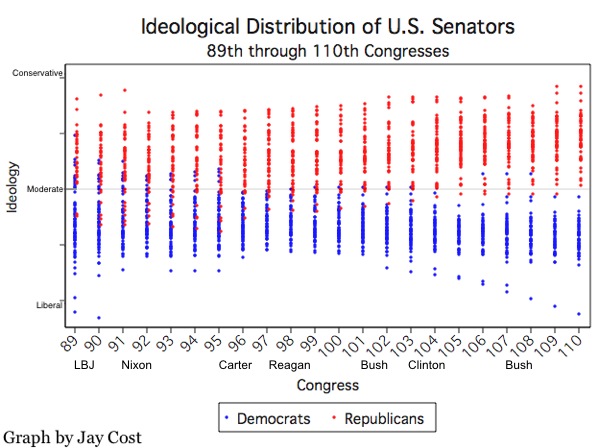
Not so fast, says Jay Cost of Real Clear Politics. While Klein thinks that the Senate is "broken," Cost thinks the Senate is working just fine. The problem is that the two Senate parties have grown farther apart over the last 40 years. He explains by using the following graph:


He then goes on to explain:
Three important trends are evident from this picture. First, the party extremes have grown farther apart. Second, there are now fewer genuine moderates in the United States Senate than at any point in the last half century. Third, there used to be a sizeable ideological overlap between the two parties in the Senate. It no longer exists. Put simply, the Senate parties have become ideologically polarized.

This helps explain the increasing use of the filibuster. As the parties drift apart ideologically, the majority party will more likely introduce legislation that the minority party can't accept, giving the latter a stronger incentive to block it via the filibuster. Using the filibuster is thus a rational response when one finds oneself in the smaller half of a polarized chamber, which is more likely to be the case today than 45 years ago.
Cost goes on to explain that removing this tool would make the upper chamber a more chaotic place. The majority party would only have to convince 51 rather than 60 Senators and they would pass more partisan legislation because there would be no check to moderate legislation. Also Cost notes that this would make for unstable policy coming from Washington. Legislation passed when one party is in power would be rescinded when the other party comes to power. Cost notes:
If nothing more than a simple majority is necessary for sweeping changes, what stops a newly victorious party from undoing all the reforms implemented by the old majority, and instituting its own set of big changes? What would be the long-term consequences of that? If every biennial or quadrennial election brought the prospect of big changes in public policy - how could we practically plan for the future? We all expect things in 2013 to be generally the same as things in 2009. Eliminate the filibuster, empower a bare majority to impose ideologically extreme policies, and that expectation could become unreasonable.
If you are still reading this post, you can probably guess that I am in favor of keeping the filibuster. As Cost notes, moderates are becoming less and less rare in the Senate, and Congress as a whole. It was the moderates that were the dealmakers that could get legislation passed. A bill proposed by the Democrats would have some Republican support and visa versa. But as the parties become more polarized, it only makes sense that when one party proposes a bill, the other party will oppose it. It also means that the party in power is really in power and the filibuster is the only tool the losing party has.

Klein and others are mad that there had to be so much work done to get 60 votes for health care to pass. If there were no filibuster then a health care reform bill would pass, probably with a public option. The remaining moderates in the Democratic party would be sidelined, and the liberal base would become even more powerful. That would be music to Klein's ears, but I think it would be bad in the long run for American democracy.

Part of the problem with our polarized climate today is that when one party wins an election, party stalwarts tend to think this is a mandate from the people to get their own agendas done. They also think that a losing party basically has to sit there and take it. So, in the health care debate, Democrats think that all Republicans should basically shut up since they won the election.

But this isn't a pure democracy, it's a republic that believes that even minorities have to be listened to. People may not like that the GOP was threatening to use the filibuster, but is the only voice the GOP had. The same goes for when the Democrats were the minority party. They need to be able to have some say in how a bill is crafted and absent bridge building moderates, this is how minorities can speak.

Too the winner goes the spoils might work in sports, but not in politics.

Wednesday, December 30, 2009

The Ambassador Who Came In From the Cold?

More than a few Republicans were sad when Utah Governor Jon Huntsman gave up his job and his presidential ambitions to become Ambassador to China. However, Dan Gerstein of Forbes writes that the public shouldn't write off Huntsman yet:

My bet: Huntsman resigns his post in the summer, frees himself up to campaign for GOP candidates in the fall, then forms an exploratory committee by year's end. He'll start out behind, and he'll have to deal with the baggage of being tied to Obama. But Huntsman, who worked in the Reagan White House and helped lead his family's global chemical company, brings a lot of comparative advantages to the table. He hails from a pivotal electoral region for the GOP; he is far more engaging and genuine than the flat Pawlenty and the flip-flopping Romney; and he can match if not beat Romney on economic policy credibility without his fellow Mormon's corporate-raiding baggage, which will be an issue in the post-bailout era. So expect him to at least be in the (ahem) hunt.

If this becomes true, it would be wonderful for the GOP. Huntsman is definitely a candidate that could appeal to "Whole Foods Republicans" and expand the party's reach.

Will it come true? We shall find out in the coming year.

Tuesday, December 29, 2009

The GOP Health Care Political Theater

The new meme going in conservative circles is to try to repeal whatever health care overhaul passes next year. The 2010 campaign theme coming from GOP pols and activists is to repeal the bill.

I have to admit that it's a clever strategy. Too bad it won't work.

As Dave Weigel notes, even if the GOP wins one or both houses next year, they will still have to face some hurdles- like President Obama:

But as Republicans gravitate towards a repeal message for the 2010 elections, they’re running up against the reality that health care reform would be prohibitively hard to roll back. According to conservative health care analysts, legal analysts, and political strategists, if President Obama signs health care reform into law, Republicans will have extremely limited opportunities to repeal any part of it.

“Anyone who thinks they’ll be able to repeal ObamaCare is kidding themselves,” said Michael Cannon, director of health policy studies at the libertarian Cato Institute. “If they want to stop it, they need to stop it now.”

In conversations with TWI, conservatives identified a few hurdles for a hypothetical, repeal-minded GOP Congress. The first is that in their most optimistic scenario, in which Republicans like Barton and Bachmann hold committee chairmanships, Barack Obama will be president, wielding a veto pen, until at least January of 2013. The second hurdle — one that Republicans aren’t considering, but Democrats are — is that once it passes, health care reform will win back public support. And the third hurdle is a provision of the bill that, according to Sen. Jim DeMint (R-S.C.) and other conservatives, may not ever be subject to new legislative oversight. The road ahead for repeal looks so daunting that many conservatives are looking at legal challenges, not GOP wins, as the most promising way to challenge health care reform.

The thing is there will be no attempt to repeal the bill. Why? Because it's pretty hard to repeal a law, let alone one that is basically an entitlement. Have Republicans pushed back Social Security or Medicare? Nope. It might be a bad bill, but it's still a bill that will give more Americans access to health care. The minute this bill becomes law, it becomes a third rail in American politics.

If the GOP wanted to make a real difference, they would have worked with Democrats and make hard bargains to come up with a bill everyone could agree with. But for the most part, they chose to sit this one out.

So, why is the GOP trying to make this a centerpiece of their campaign in 2010? I think the answer is to please the party activists. Stuart Taylor sums this up in a post back in November about the polarization of political parties. Taylor cites Morris Fiorina, the author of Disconnect: The Breakdown of Representation in American Politics who believes that the American public tends to be more moderate than the political elites and activists. As political moderates are driven out of both political parties, politicians focus more on pleasing the base than in offering solutions. Which is why the GOP is pushing this plan and why they have sat out the health care debates. The moderates in the party that would have made the deals have either left the party, retired or lost in recent elections. What's left are those who care more about party purity than they do in legislation.

What we have in the repeal movement is political theater. It's a good show, but in the end all it's just entertainment.

Monday, December 28, 2009

Big Tent Democrats?

I've done more than a few posts on the quest by some in the GOP to want shrink the so-called "Big Tent." Many of us have looked at how the Democrats have been able to welcome both liberals and moderates in the party.

However, two articles from two Democrats show that the Left is having its own problems on trying to reach and keep moderates and also please its base.

On Christmas Eve, former Commerce Secretary William Daley wrote in the Washington Post about trying to keep the Dems open to all viewpoints. He notes that Democratic wins in 2006 and 2008 was because the party reached out beyond its liberal base. It was because of the Big Tent, that Dems started winning in Republican-leaning districts for the first time in a long time. But all is now well in the party of FDR. Daley notes that currently liberals in the party are attacking their Centrist brothers and sisters for not being pure enough.

On the one hand, centrist Democrats are being vilified by left-wing bloggers, pundits and partisan news outlets for not being sufficiently liberal, "true" Democrats. On the other, Republicans are pounding them for their association with a party that seems to be advancing an agenda far to the left of most voters.

The political dangers of this situation could not be clearer.

Witness the losses in New Jersey and Virginia in this year's off-year elections. In those gubernatorial contests, the margin of victory was provided to Republicans by independents -- many of whom had voted for Obama. Just one year later, they had crossed back to the Republicans by 2-to-1 margins.

For Daley, the solution is to realize that what might be the agenda of the liberal base might not be the agenda of all Americans:
All that is required for the Democratic Party to recover its political footing is to acknowledge that the agenda of the party's most liberal supporters has not won the support of a majority of Americans -- and, based on that recognition, to steer a more moderate course on the key issues of the day, from health care to the economy to the environment to Afghanistan.

For liberals to accept that inescapable reality is not to concede permanent defeat. Rather, let them take it as a sign that they must continue the hard work of slowly and steadily persuading their fellow citizens to embrace their perspective. In the meantime, liberals -- and, indeed, all of us -- should have the humility to recognize that there is no monopoly on good ideas, as well as the long-term perspective to know that intraparty warfare will only relegate the Democrats to minority status, which would be disastrous for the very constituents they seek to represent.

Nonsense, says Robert Creamer, in the Huffington Post. The political organizer sees any attempt to become more "moderate" as nothing more than bowing to the political interests that got us into this mess called the "Great Recession." Creamer believes the nation voted for substantial change is the Democrats must deliver on this change:


"Moderating" our goals is not a recipe for victory. It is a recipe for failure. Last fall, voters overwhelming voted for change, and they knew then -- and still know now -- the kind of change they wanted.

They wanted to end the stranglehold of the private insurance companies that continues to put every American a single illness -- or one layoff -- away from financial catastrophe. They want to take bold, clear action to assure that America is in the forefront of creating the clean energy jobs of the future -- and leave a thriving healthy planet to our children. They wanted to fundamentally change the bull-in-the-china shop foreign policy of the Bush years and re-establish American leadership in the world. Most importantly, they rejected the failed economic policies that allowed the recklessness of huge Wall Street banks to plunge the economy into free fall -- and cost millions their livelihoods. They desperately want leadership that will lay the foundation for long term, bottom-up, widely shared prosperity.

In other words they wanted... and still want... fundamental change.

Why does this all sound so familiar to me?

I think what Daley and Creamer show is that polarization really is taking place within the two parties, leaving those not "pure" enough out in the cold. Both hard core liberals and conservatives feel they have a pulse on what America wants and misinterprets an election win for a mandate for radical change.

But of course, they don't understand the outside because their whole political lives are spent inside a bubble of their own making. Moderates in both parties tend to be the ones that know that all of America isn't Berkley or Alabama. They are the ones that have a foot in reality.

Maybe what could happen is that moderates in both parties get tired of being treated like crap and create one or two political parties that are more in tune with the pulse of America. One can hope.

Links of Note

A Republican Senate candidate in Illinois is spreading rumors that his primary opponent, moderate GOP Congressman Mark Kirk is (gasp!) gay.

Tea Partiers are calling for Republicans to support a full repeal of the Health Care overhaul or face the consequences.

Republican Jim Depeso thinks Copenhagen can give you a job.

Wednesday, December 23, 2009

That Ought to Teach Them

The GOP gambled big in not working with the Democrats. Some have hoped the bill passes and then the Democrats will be tossed out of Congress in 2010 because of the health care overhaul. But if anyone thinks this means health care reform would be repealed by the GOP, they've got another thing coming. Republican Senator Mike Crapo of Idaho reports that there is very little chance that the GOP would ever repeal the bill.

Of course they aren't going to repeal the bill. Does anyone really think the GOP would basically end a federal program giving health care to millions? It would be political suicide. Also, for all the talk we Republicans do about waste in goverment and about living within our means, we are really bad about doing it when push comes to shove. It's easy to talk about cutting spending, harder to do it.

But also it is almost impossible to remove a government program once it has been enacted, especially if it is an entitlement program. It's not a cakewalk to reform a program either.

So the GOP took a gamble and lost. One wonders what would have happened if the GOP had been willing to bargain, to support expanded access but to also find ways to control health care costs and to make sure this doesn't blow a hole in the deficit.

But we didn't and we won't. Nice work, guys.

Michelle Bachmann the Welfare Queen

TruthDig has an interesting article on Michelle Bachmann, the Minnesota Republican Representative who seems to never find a moment to talk about the coming "socialist takeover" by the President. But it turns out that Ms. Bachmann is also living off the dole:

Tuesday, December 22, 2009

Myth of a Center-Right Nation?

Progressive blogger Ed Kilgore thinks the belief that the United States is a "center-right" nation is not as true as some would like to think:
Yes, polls of self-identification on this scale do show a very stable "center-right country" in which conservatives typically outnumber liberals three-to-two or even more. This is how Scott arrives at his fundamental argument that polarized elected officials don't adequately represent the people who elected them, and also how he somehow concludes that the notable shift of Republican opinion to the right in recent years has made the system more, not less representative (that's his major refutation of the Hacker-Pierson contention that the GOP has dragged the political center to the right).


Self-identification measurements are always iffy, as is made most evident by the vast gap between the number of voters who call themselves "independents" and the number who actually behave in an independent manner. But the hoary liberal-moderate-conservative scale is particularly influenced by the unpopularity of the "liberal" term, even among many voters who are "liberal" by the normal standards. This is what conservatives have bought with so many years and so many billions of dollars invested in the demonization of "liberalism," compounded by the very different meanings the term has denoted here and abroad.

The kicker here though is what this belief in a "center-right nation" does to the GOP:


It’s worth noting as well that the “center-right nation” meme has the perverse effect of holding Democrats to a higher standard of “bipartisanship” than Republicans, since “liberals” obviously have to move further to reach the actual political center than “conservatives.” And indeed, that’s pretty much what Scott suggests.

Now, Kilgore is a lefty and this is a blog with a liberal bias, but he does share some truth here. I believe one of the reasons that the Republicans have for the most part held their ground and not cooperated with the Democrats is on the belief that the American people don't want a "government takeover of healthcare." They believe that the public is on their side since this is a "center-right nation." In essence, they believe they don't have to give an inch because most of the nation agrees with them ideologically.

But is that really true? Voters put a Democratic Congress and a Democratic President in office last year. The Democratic President said he was going to reform health care and yet voters voted for him. Also this Democratic President is the first Northern Liberal in the White House in about two generations. If we are such a center-right nation, one would think that President Obama would have had a hard time getting elected.

The danger of believing that we are a center-right country is that it allows Republicans to live in denial. Why do they have to change? Why bother with trying to appeal to independents, or why bother running moderates in Democratic areas? The last two elections should have woken us up and allowed us to make strategic changes, but the belief in the center-right nation allows us to think that 2006 and 2008 are abberations and that sooner or later, America will come back home to the GOP.

But I think there is even a bigger danger: it leaves Republicans thinking they don't have to solve issues like health care reform or the environment, or the economy. Their vision of the right makes these issues irrelevant.

2010 will be an interesting year to find out if this belief in a center-right nation is real or just something a convenient little lie to hold on to during hard times.

What's In a Name?

I've noticed that E.D. Kain has changed the name of his blog over at True/Slant from "American Tory" to "American Times." 

I'm wondering what's up with that.  I don't know the reason behind this name change, but my own guess is Kain's frustration with the current state of conservatism.  Could this mean he is leaving conservatism?

Dunno.  We will find out.

Monday, December 21, 2009

Snowe Will Vote No

There has been a fair amount of talk that the reason Republicans are voting against the health care overhaul is because they either a) don't care about the plight of the uninsured or b) are betting on voters to punish the Democrats in 2010 for this bill.

Of course, there are such people among the GOP in both the House and the Senate.  However, not every Republican is against this bill for cynical reasons.  Some do have honest to goodness objections to the bill.  One such person is Maine's Olympia Snowe.  The New York Times reports today, that she is going to vote against this health care overhaul.  Back in fall, she was the only Republican to vote for the bill in committee.

Her objections are not steeped in rhetoric but in some genuine concerns that she has about the bill and the speed in which it is being passed:

Unlike the barrage of attacks unleashed on the bill by her Republican colleagues, Ms. Snowe’s criticism is particularly devastating for the Democrats. In many ways, Ms. Snowe seems to want to vote for the health care bill even more than some of the reluctant centrists who will provide Democrats with the pivotal votes.


In Ms. Snowe’s view, Democrats are rushing the bill unnecessarily. In a recent interview, she warned that Congress would spend years fixing the bill if it was adopted in her current form. She recalled her days in the Maine state legislature, where legislation titled “errors and inconsistencies” would be needed to correct mistakes – in the Congress such legislation is often referred to as “technical corrections” and she said many such corrections would be need on the health measure.

There are a number of GOP pols that have said that things are being rushed. But of course many of them don't really mean what they are saying. What they want is to block the bill. But Snowe has never been one of those people. She has honestly wanted health care reform and has been willing to cross party lines to support the bill. But unlike what has been the popular charactacher of centrists, she can't in good conscience support the bill. Here is a portion of her formal statement:

Having been fully immersed in this issue for this entire year and as the only Republican to vote for health reform in the Finance Committee, I deeply regret that I cannot support the pending Senate legislation as it currently stands, given my continued concerns with the measure and an artificial and arbitrary deadline of completing the bill before Christmas that is shortchanging the process on this monumental and trans-generational effort.

Only three weeks ago the Senate received a more than 2,000-page bill on one of the most complex issues in our history, and we have since considered fewer than two dozen amendments out of more than 450 filed. A little over 24 hours ago, the Senate received a final, nearly 400-page manager’s amendment that cannot be changed or altered, with more than 500 cross references including to other statutes and will be voted on at 1 a.m. Monday morning. It defies logic that we are now expected to vote on the overall, final package before Christmas with no opportunity to amend it so we can adjourn for a three week recess even as the legislation will not fully go into effect until 2014, four years from now.

I remain convinced we must work toward a responsible, common sense solution to reverse the trend of spiraling health care costs — that will cause one-in-four Americans this year to have either inadequate coverage or none at all, and threatens affordable coverage for millions more Americans in the future. As I pledged to the president in an Oval Office meeting Saturday afternoon, I couldn’t agree more that reform is an imperative, and I will continue my constructive efforts to forge effective, common sense health care reform as the process moves into a House-Senate conference.

I personally don't know where I stand on this bill. Like Snowe, health care reform is important for me. But I worry how cost effective it will be in the long run. I am upset that it doesn't sever health care from our work, a holdover of the post-war era. I worry that it just might bust the budget.

Not every Republican who shares misgivings is against any health care reform. When we are on the cusp of making a big change in American society, some of us want to make sure that it is done right.

Sunday, December 20, 2009

On Cohesion and Innovation

Jim Manzi writes a go-to article in the winter issue of the conservative wonk magazine National Affairs. He makes a good case for the social problems that we face as a nation and how we can best solve them without losing our economic edge. It's also a good criticism of the Obama plan that doesn't rely on mindless shouts of "socialism!" all the time.

Monday, December 14, 2009

“Whole Foods Republicans”

My latest at Republicans United.“Whole Foods Republicans”

Sunday, December 13, 2009

When 95 Percent is a Failing Grade

With all the talk lately about "purity tests" in the GOP, here's a story about one conservative lawmaker in California who is paying the price for voting his conscience over party.

Friday, December 11, 2009

Good Mitch, Bad Mitch

My latest over at Republicans United.

Good Mitch, Bad Mitch

Monday, December 07, 2009

The Purity Tests and the Moderate Republican

As I've been reading all the blog posts about the so-called "purity test" resolution for future GOP candidates, one question has been going around and around in my brain:

Why do we care?

Tuesday, December 01, 2009

Things of Heaven...Stuff of Earth

The whole sorry tale of Maurice Clemmons and his life of destruction has led me to think a lot about Mike Huckabee. The former Arkansas governor is getting his share of blame for allowing Clemmons to walk free. Most of the political bloggers that I follow tend to view his road to the presidency as kaput.

Now I don't really like Huckabee's views on various issues. But right now, I feel sorry for man. Because while he made a big mistake in releasing an animal like Clemmons into the public, I think he did it for the right reasons.

What is interesting right now is how some tend think that relying on religious beliefs while in office is somehow dangerous. While one should rely on all aspects of knowledge, to say that a politician must not be informed by their faith is ludicrious. Christianity, and any other religion for that matter, is a worldview that informs all parts of an adherent's life. It is impossible to say that religious views be kept somewhere on the coat rack of life while we live our lives. For any adherent, it is the fabric of life.

Religion informs people's choices on all sorts of matters. Many of my liberal friends who support universal health care do so for religious reasons. Same goes for those who oppose abortion or war. The problem isn't that we have these views, the problem lies in how they are used.

The case of Clemmons poses hard questions because it strikes at the heart of something that both Huckabee and I strongly believe in: redemption. The belief that people can change their ways and live right, to turn away from wrong is at the heart of Christianity. We are taught of a loving God who cared for us even when we did wrong and compels us to live righteous lives. For a Christian, it is not enough that the we believe this, it is something that must be lived out, just as we believe Jesus did when on earth.

When Huckabee pardoned Clemmons, I have to believe he did it because he truly believed Clemmons' sob story of having changed. He wanted to live out his faith and he believed this man had been redeemed.

That's of course, the danger here. We try to live as followers of Christ in an imperfect world. We try to show love and mercy to a fellow human being and he in turn kills four cops who were just trying to get some paperwork done.

So what do we do? Some bloggers say simply that Huckabee should have simply thrown away the key. He should have known better. Once a skunk, always a skunk.

Maybe a future politician will do what many politicians do and ignore their religious beliefs and keep more felons in prison and maybe even execute a few to show the public he/she means business.

The citizen in me says just that: lock 'em up. But the pastor in me, the one who wants to try to live as Jesus did, wonders if doing that is the right thing. The pastor wonders if everyone that asks for mercy is a snake, or if some really are wanting to make a change for the better.

Joe Carter, in his excellent post about Huckabee muses that the governor was naieve. Maybe so, but isn't Christianity at its root somewhat naieve? It preaches love in a world filled with hate. It's hardly a rational faith.

The problem for all Christians, and maybe for everyone who has a faith is knowing when to as the Bible says, be wise as serpents and when to be innocent as doves. When can we allow for heaven to break through on earth, and when to realize that heaven is not here yet.

It's a problem I wish pastors dealt with more. Because while we want to have some heaven here on earth, we live in this world filled with grays. How do we strive to be a loving a forgiving people in a world of Maurice Clemmonses?

What has been frustrating to me is that few if any religious blogs are talking about this issue. I have searched and searched and found none at all. I find that amazing. Maybe we don't want to admit that this is hard issue. But it would be honest.

Mike Huckabee made the moral choice in wanting to give someone a second chance. But in this case, it was not the right choice and four dead police offers are the result.

Charles Johnson's Jaundiced View of the Right

Charles Johnson, who runs the blog known as Little Green Footballs, has written a major post on the blog where he breaks his ties with the Right. He shares 10 reasons for his break with the right:

1. Support for fascists, both in America (see: Pat Buchanan, Robert Stacy McCain, etc.) and in Europe (see: Vlaams Belang, BNP, SIOE, Pat Buchanan, etc.)

2. Support for bigotry, hatred, and white supremacism (see: Pat Buchanan, Ann Coulter, Robert Stacy McCain, Lew Rockwell, etc.)

3. Support for throwing women back into the Dark Ages, and general religious fanaticism (see: Operation Rescue, anti-abortion groups, James Dobson, Pat Robertson, Tony Perkins, the entire religious right, etc.)

4. Support for anti-science bad craziness (see: creationism, climate change denialism, Sarah Palin, Michele Bachmann, James Inhofe, etc.)

5. Support for homophobic bigotry (see: Sarah Palin, Dobson, the entire religious right, etc.)

6. Support for anti-government lunacy (see: tea parties, militias, Fox News, Glenn Beck, etc.)

7. Support for conspiracy theories and hate speech (see: Alex Jones, Rush Limbaugh, Glenn Beck, Birthers, creationists, climate deniers, etc.)

8. A right-wing blogosphere that is almost universally dominated by raging hate speech (see: Hot Air, Free Republic, Ace of Spades, etc.)

9. Anti-Islamic bigotry that goes far beyond simply criticizing radical Islam, into support for fascism, violence, and genocide (see: Pamela Geller, Robert Spencer, etc.)

10. Hatred for President Obama that goes far beyond simply criticizing his policies, into racism, hate speech, and bizarre conspiracy theories (see: witch doctor pictures, tea parties, Birthers, Michelle Malkin, Fox News, World Net Daily, Newsmax, and every other right wing source)


Looking at this list, one could conclude that this is the end all and be all of conservatism in the United States. It's definitely what many on the American Left think of Repbublicans. And while I do think there are a lot of problems in the American Right that need to be addressed, I tend to think Johnson, along with many former Republicans, tend to have a jaundiced view of the Right. They look at the most extreme elements of the Right and think that it is sum of the entire movement. James Joyner took a look at Johnson's list and offers his own view which is a lot of nuanced than Johnson's.

It might help that Joyner explains that Johnson was a liberal until 9/11 and then shifted towards the far right. As 9/11 became more and more of a distant memory, he started to see things differently. So, in one case it should not be that surprising that his views changed back to what they might have been pre-9/11.

But his post raises larger questions. As moderate, I know that my brand of conservatism is not as much in fashion. The Right is dominated by the likes of people like Michelle Malkin and news outfits like World Net Daily. But that is hardly all of what makes up the GOP or conservatism. Take for example point 8 that talks about a hate filled right wing blogosphere. The funny thing is, there are a lot of conservative bloggers that are reasonable and well thought out. I like reading Frum Forum, American Scene, Outside the Beltway and the Big Stick. The League of Ordinary Gentlemen is not a conservative blog per se, but has several thoughtful conservative bloggers.

It has always flumoxed me that those who like me, have issues with certain parts of the Right, decide to take the most extreme elements of the movement use a wide paint brush to tar everything and everyone as a nut. But there are good and thoughtful people who take on the task of being a voice of reason amid the craziness.

No doubt, Johnson will be branded as a brave for parting ways with the Right by many on the Left or with those fellow angry former conservatives. But while it might serve to reinforce all the negative views that some on the left have on the right, it does nothing to change the right. Johnson's choice of bailing out at a time when the movement needs thoughtful reformers is not one of bravery, but opportunism.

What the American Right needs now are people who are willing to stand up to the Sarah Palin/Glen Beck crowd within the movement. Leaving the movement helps no one but Charles Johnson.

Monday, November 23, 2009

Is A GOP Litmus Test Becoming a Reality?

My latest at Republicans United.

Is A GOP Litmus Test Becoming a Reality?

Thursday, November 19, 2009

What Are We Afraid Of?

There are some things that I will never understand. One of those is the uproar among many conservatives about the decision by the Obama Adminstration to try Khalid Shaikh Mohammed and others in New York, mere blocks away from the site of the World Trade Center. You'd think that Eric Holder had just released KSM out into the American public. The reasoning against putting KSM and his ilk on trial makes no sense. It makes me wonder, what are we so afraid of?

Saturday, November 07, 2009

What Does the Lord Require of Republicans?

My latest over at Republicans United.

What Does the Lord Require of Republicans?

Friday, November 06, 2009

Why Gay Marriage IS a Big Deal

Like many gay Americans, I awoke this morning to the news that Maine voted for repealing a law allowing same sex couples to marry. I was saddened by the fact. And like clockwork, a lot of my friends starting saying bad things about the people of Maine and threatening not to spend any money there.

Meanwhile, on the other side of the country, Washington State approved a referendum that allowed domestic partnerships in the Evergreen State.

The win apparent win in Washington (which has seemingly been ignored among gays and our supporters) has started me thinking about how to best allow gays marriage rights. I've vacilated between calling for full marriage equality and calling it a marriage, and asking for something like a marriage ala civil unions. Yesterday's decisions has made me think that it's time to change how we work for marriage rights.

Wednesday, November 04, 2009

Friday, October 23, 2009

Moderate Republicanism: Is It Worth Fighting For?

Fellow Republicans United blogger, Bill Golden had this to say earlier today about moderate and/or centrist Republicans:
And for moderates — you need to find some principles quick. Being “moderate” or “centrist” is a mode. If you keep standing in the middle of the road whining that no one is stopping to give you a kiss … then you are just going to get your arse run over. Become a liberal, libertarian or conservative or whatever, but get some principles and go with it. Defend them. Live them. Be “moderate” when it comes to time to work out agreement but please stop standing in the middle of the road.


It made me think a lot about the fate of the so-called moderate Republican, a moniker that I have long used to describe myself. I have been long frustrated with my fellow moderates for some the reasons that Bill has argued, specifically, that we tend to stand in the middle of the road whining that no one will give us a kiss. And because we sit there whining about the state of moderates in the party, we ended up getting our asses handed to us again and again.

I know that I might hurt some feelings here, but I am starting to think that a lot of moderates are some of the most feckless, flighty and downright cowardly people. We do not stand up for our convictions. At times, I wonder if we even have convictions. We whine about the dwindling state of the GOP, about how it is being taken over by extremists, but when it comes down to making a difference, we offer no solutions other than pleading for the Republican leadership to love us.

Friday, October 09, 2009

About That Nobel Prize…

My take on Obama's Nobel is up at Republicans United.
About That Nobel Prize…

The War Against Dede

Politico is running a story about how some groups on the hard right are upset at National Republican Committee for supporting New York Assemblywoman Dede Scozzafava, who is running to fill the seat vacated by John McHugh. They see Scozzafava as a "liberal," a "radical" who happens to have an "R" after her name.

Here are a few exerpts from the article:
At a private Washington luncheon attended by activists last week, frustrations spilled over, and several attendees demanded to know why NRCC Chairman Pete Sessions of Texas, who was the featured speaker, was supporting Scozzafava over the more conservative Hoffman.

After Sessions conceded that Scozzafava's record on gay marriage and abortion fell short of where those at the lunch wanted it to be, he sought to defend her record on taxes. At that point, according to two sources who were present, the Texas congressman came under forceful pushback from several conservative leaders who insisted Scozzafava fell far short in that area as well.

"I was flabbergasted that he could come into a meeting of conservatives and be as defiant as he was," said one person who was at the Free Congress Foundation's Paul Weyrich lunch meeting, adding that the Texas congressman "stuck a finger in our eye."

And there's more...
Club for Growth Executive Director David Keating, whose deep-pocketed organization is already flooding New York’s North Country with ads targeting Scozzafava, slammed her as a “flaming liberal” whose politics are to the left of many House Democrats.

“The Republican Party bosses in New York state are not in touch with the Republican primary voting electorate,” said Keating. “She would never win a primary there, if there was one.”

As referenced by Keating, part of the frustration over Scozzafava is the way she claimed the GOP nomination in July — not through the standard primary election process but, rather, on the third vote taken by the 11 Republican county chairmen within the 23rd Congressional District.

Local Republicans tapped Scozzafava as the nominee in July because they believed her centrist views would appeal to a coalition of centrist Republicans, independents and Democrats in a moderate-minded district that Barack Obama won with 52 percent of the vote in 2008. The national party supports her for the same reason: her perceived electability.

This is a case where the wingnuts are...well acting like wingnuts and the national party is acting more pragmatic. The hard right is not concerned about winning as much as they are about being heard, even if it means handing the seat to a Democrat.

As I've said before, if one were to look at Scozzafava's record, one would see that she is not a flaming liberal. But then to those on the hard right, anyone to left of a Ghengis Khan is a commie.

I think that those who believe in a politically diverse party should consider donating to Dede's campaign. Let's not let the crazies torpedo another good Republican.

Wednesday, October 07, 2009

Why I’m Not a Token

Below is a link to my latest over at Republicans United.

Why I’m Not a Token

Thursday, October 01, 2009

Deficits DO Matter, Continued

James Pethokoukis has a post about how President Obama might just raise taxes by instituting a Value Added Tax or VAT that has been used in European countries. Pethokoukis isn't that crazy about adding a VAT, but would give it some support if some deals were made:

Obama wants a VAT? First, it should be part of broader tax reform, including getting rid of capital gains and corporate taxes. Second, it should accompany an Economic Bill of Rights much like Ronald Reagan used to suggest. Its elements: a) a balanced budget amendment, b) a line-item veto, c) a spending limit such as inflation plus population growth, d) and a two-thirds vote in the House and Senate for any tax increases. (Reagan also wanted a prohibition on wage and price controls. That would likely kill ObamaCare.)

And come to think of it, let’s cut spending and streamline government before cash-strapped, wealth-reduced taxpayers are forced to pony up a penny more, OK?


This is yet another example of how the GOP is not really serious about fiscal policy. I don't want to soak-the-rich-either for many of the same reasons that Pethokoukis does (though I do support letting the Bush tax cuts to expire), but the requirement of a supermajority to pass taxes is just lame.

Why? Well, I'm not an economist, but let's consider a state that DOES have a supermajority rule: California. That state is not the shining example of fiscal stability. Pethokoukis and others on the Right tend to think that if one makes raising taxes harder, then no new government programs (and therefore spending) will come to fore.

However, what Pethokoukis forget is that why it might stymie governments from raising taxes, such a law does nothing to slow spending. As long as the wider public can believe that one can get all the goodies from the government without paying more, then spending will increase. And when spending outpaces revenue, we have a funny little thing called a deficit.

Over the past 8 years, the GOP did not raise taxes, but they spent and spent and spent. There was no ephasis in cutting spending, because as much as people don't want their taxes raised, they do expect the government to cater to their every whim and fancy.

The GOP needs to take part in a "fiscal Lent" where we take stock in our fiscal record and decide to reform. We need to stop with all the silly gimmicks that only fool the people and actually try to find ways to provide good government services efficiently and for little cost.

That's a long way of saying call me when you are serious.